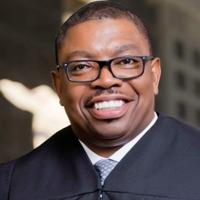

Cook County Circuit Judge John F. Lyke Jr.
CHICAGO — As Cook County's courts begin the process of trying accused cop killer Alphonso Talley, attention has turned to questions over how it was that a Cook County judge repeatedly allowed Talley back on the street to violently reoffend, ending in the shooting of two Chicago Police officers at a Chicago hospital, leaving one dead and the other severely wounded and clinging to life.
And much of that spotlight is now being turned to Cook County Circuit Judge John Fitzgerald Lyke Jr., the judge who largely handled Talley's criminal proceedings for years.
Talley, 26, is charged with numerous counts in connection with the Saturday, April 25, shooting at Swedish Hospital that killed Chicago Police Officer John Bartholomew, 38, and severely wounded Bartholomew's partner, 57.
Prosecutors have charged Talley with first degree murder, attempted first degree murder and a long list of other felony charges for armed robbery, battery, illegal gun possession and attempting to escape police custody, among others.
According to published accounts, primarily in detailed reporting by Chicago criminal justice news publication CWB Chicago, police arrested Talley, a seven-time convicted violent felon, on belief that he was one of two men accused of an armed robbery at a Family Dollar Store on Chicago's Northwest Side.
According to published reports, when officers arrested him, Talley allegedly complained of illness, asserting he had swallowed packets of illegal narcotics. According to CWB reports, Talley had allegedly similarly feigned illness during previous arrests as part of a ploy to be taken by officers to hospitals, rather than to police lockup.
This time, however, while in an examination room awaiting medical tests, Talley managed to obtain a gun stashed under a blanket and shot the two officers assigned to guard him, shooting Bartholomew in the head and killing him instantly and then shooting Bartholomew’s partner in the face.
He then reportedly shot through the hospital window, leaped out and attempted to flee naked. He was reportedly arrested hiding in a residential yard nearby.
However, reporting, primarily by CWB, revealed the incident was just perhaps the final act in a spree of violent crime committed by Talley when he had already been convicted in recent years of violent crimes; was already facing new charges for violent crimes, including carjacking and armed robbery; and was supposed to be on electronic monitoring under the watch of the Cook County Chief Judge's office.
According to CWB, Talley has faced charges in connection with violent crimes in Chicago since at least 2017, when he was convicted of attacking and robbing five men in Chicago's Boystown and River North neighborhoods.
According to CWB, in ensuing years, Talley was further convicted of illegal gun possession; possessing a stolen vehicle and fleeing police; and battery against correctional officers while in jail.
However, when he appeared again in court in 2024, Judge Lyke reportedly still refused to hold Talley in jail, instead releasing him back into the community, first on electronic monitoring and then on his own recognizance.
Electronic monitoring, which typically requires defendants to wear ankle monitors that supposedly allow officers to track their movements, has been touted for years by Cook County courts officials, Democratic state lawmakers and criminal justice reform activists, among others, as a better alternative to pre-trial detention in the county jail.
Judges are not required to grant electronic monitoring, and could order defendants detained.
However, judges are instructed to defer to such jail alternatives as often as possible under the dictates of Illinois' so-called SAFE-T Act criminal justice reform laws, which prohibited the prior traditional bail-bond system, in the name of racial justice and equity.
Those reforms have been touted and championed by Illinois and Chicago Democrats, particulary in Chicago, including Gov. JB Pritzker, former Cook County Chief Judge Timothy Evans, former Cook County State's Attorney Kim Foxx and Cook County Board President Toni Preckwinkle, among many others.
Months after being released, Talley disappeared, no longer appearing in court as required.
According to CWB, Talley was arrested again two months later for allegedly teaming with another man to carjack a woman at gunpoint and then using her vehicle to allegedly rob another man at gunpoint in Englewood.
After Cook County Judge Luciano Panici agree to detain Talley, Lyke in December 2025 released him once more onto electronic monitoring several months later.
According to a report published by CWB, court transcripts reveal Lyke agreed with the Cook County Public Defender's Office that Talley had made strides while in jail toward changing his behavior, including completing classes on anger management, among others. Further, Lyke reportedly noted that Talley's son had been born while he was in jail.
According to the CWB report, Lyke reportedly stated his belief that Talley had "matured," and that he committed his earlier crimes when "from a physiological standpoint, his brain wasn't fully developed."
“It appears his mind is finally developing and he may be on the path to making better decisions,” Lyke said, according to the report published by CWB.
During the hearing, Lyke noted Talley's "egregious" criminal record, which he said could "in certain instances shock the conscience."
And Lyke noted that under the state's former cash bail system, he could have set a bond of up to $1 million for Talley, with 10% to apply, meaning Talley could have needed to pay $100,000 to get out of jail. However, since that system was removed by the reforms of the SAFE-T Act, Lyke reportedly noted he must decide between ordering Talley detained or granting the request from the Public Defender for electronic monitoring.
According to CWB, Lyke granted the request for electronic monitoring release over the "strenuous objections" of the Cook County State's Attorney's Office, under State's Attorney Eileen O'Neill Burke.
According to CWB, Lyke said he could "not find that the state has met its burden by clear and convincing evidence that there is no condition or combination of conditions that this court can impose to protect any person or persons in the community when weighing everything with a fresh set of eyes and understanding."
However, while on electronic monitoring, Talley reportedly violated terms of his prior parole through the Illinois Department of Corrections, repeatedly violated the terms of his electronic monitoring, and again stopped coming to court on required dates.
Lyke later issued a warrant for Talley's arrest.
However, despite his numerous electronic monitoring violations, parole violations, and active arrest warrant, Talley was not again taken into custody until he was arrested for the Family Dollar robbery on April 25, leading to the shooting of the two Chicago Police officers assigned to guard him at the hospital.
JUDGE JOHN FITZGERALD LYKE JR.
Lyke has been a Cook County judge since 2016, when he was elected as a countywide judge.
Lyke ran unopposed in the Democratic Party primary. He received the endorsement of the Cook County Democratic Party.
The candidate endorsement and slating process was led at the time by former Cook County Assessor and Cook County Democratic President Joseph Berrios. The process is currently led by Preckwinkle, who replaced Berrios as Cook County Democratic Party president.
According to campaign finance records, Lyke enjoyed strong support in his campaign from influential Chicago legal figures, including Larry Rogers Jr. and Joseph Power, principal partners at the firm of Power Rogers & Smith, of Chicago.
According to state campaign records, Rogers served as chair of Lyke's campaign committee.
Lyke's campaign also received donations from law firms and lawyers from the firms of Erickson & Oppenheimer; the McDermott Law Group; the Ghouse Law Offices; Salvi Shostock & Pritchard; and attorney Darryl Robinson.
According to campaign finance records, before becoming a judge, Lyke donated $2,000 to the campaign of Illinois Supreme Court Justice Joy V. Cunningham, along with much smaller donations to other Illinois and Chicago Democrats through the years, including Antonio "Tony" Munoz; Judge Thaddeus Wilson; Roderick T. Sawyer; Judge Rossana Fernandez; and Illinois Attorney General Kwame Raoul.
He also donated to the Rich Township Democratic Organization and the Cook County Democratic Party, as well as the Committee for Retention of Judges in Cook County.
Lyke won retention in 2022, giving him six more years on the Cook County bench. He will next face voters for retention in 2028.
According to reports published by Northwestern University and Lyke's alma mater, the Chicago Kent College of Law, Lyke grew up poor in public housing in Chicago's crime- and gang-plagued Robert Taylor Homes.
He enlisted in the U.S. Army after high school.
Following his discharge, Lyke studied law in college, reportedly with the goal of helping "people who look like me."
In published comments, Lyke reportedly said he was motivated to go to law school in part because he "saw a lot of, in my opinion at the time, maltreatment of African Americans, people who look like me, by the police" while he grew up in the housing projects.
From law school, Lyke reportedly reluctantly went to work as a prosecutor for the Cook County State's Attorneys Office. However, he says he did so only after a mentor reportedly told him that he could choose not to press charges against accused criminals.
“If you think injustice has been done, you have the power as a prosecutor to dismiss the case or reduce it down to where your version of justice may be had,” Lyke said his mentor, Judge David Erickson, told him.
After leaving the state's attorney's office, Lyke then worked as a criminal defense attorney and in 2023, he said he was "most proud" of that part of his career.
Lyke has credited his Christian faith with helping to inform his approach as a lawyer and a judge, asserting he believes accused criminals must "be held accountable for (their) actions)," while he still tries to find the "good in all of us."
Lyke's own son was the victim of violent crime, surviving three gunshots when a gunman opened fire near a funeral for a school friend.
Lyke has asserted he "wasn't angry at the person" who shot his son, saying "as a Christian, I love him, too" and understands the gunman "has problems as well."
In the 2023 article, Lyke reportedly said he was troubled by the "level of disrespect for the rule of law or for law enforcement" calling it "rampant."
In that article, he reportedly said: “Our nation is at a crossroads. As I look at the news and the internet and I see all this violence just permeating across the country, you have to hold people accountable or they will continue to do whatever they do.
"If there are no consequences to violence, if there are no consequences to breaking the law, there’s no consequences to disrespecting the law and those who are in charge of enforcing the law, we as a country are in trouble.”
The shooting of officers by Talley marks the second time in recent years that Cook County judges have come under scrutiny for repeatedly releasing a criminal who went on to commit heinous crimes.
In 2025, attention focused on rulings by judges Teresa Molina-Gonzalez and Ralph Meczyk which kept Lawrence Reed out of jail, despite a long list of criminal offenses. Reed would go on to allegedly light a woman on fire in an unprovoked attack on a CTA train.
The firestorm that followed that incident led to new Cook County Chief Judge Charles Beach to undertake a review and reforms of the Cook County electronic monitoring system. According to CWB, those changes to the system did not prevent Talley from absconding and committing the heinous crimes he is now accused of.
Molina-Gonzalez will next go before voters later this year and Meczyk in 2030 during so-called "retention" election. In those elections, voters will be asked if they wish to "retain" those judges, among other incumbent judges on the ballot.
Voters will be asked to vote "yes" or "no."
If judges fail to secure 60% "yes" votes, they would be removed from the bench.