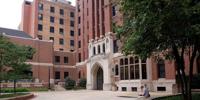


Moody Bible Institute, Chicago
CHICAGO — The Chicago Public Schools have dropped their alleged efforts to block students from a Chicago evangelical Christian college from participating in their student teacher programs, quickly settling a lawsuit accusing them of using "non-discrimination rules" to allegedly unconstitutionally discriminate, in turn, against those students on the basis of the school's traditional Christian doctrinal beliefs.
The settlement was announced in Chicago federal court on March 12, ending the action brought against the Chicago Board of Education by Moody Bible Institute.
The Chicago Board of Education governs CPS.
In a statement announcing the settlement, attorney Jeremiah Galus, of the conservative non-profit constitutional rights advocacy group, the Alliance Defending Freedom, said: “Chicago desperately needs more teachers to fill hundreds of vacancies, and Moody’s students will be well-equipped and qualified to help meet that need.
"Moody holds its faculty and students to high standards of excellence, and we’re pleased to reach this favorable outcome that will allow it to participate in Chicago Public Schools’ student-teaching program. We’re hopeful other public officials will take note that they can’t inject themselves illegally and unconstitutionally into a religious non-profit’s hiring practices.”
Moody had sued CPS about four months earlier, near the end of 2025, accusing CPS of locking its student elementary teachers out of student teaching opportunities in Chicago public schools, allegedly violating their constitutional rights to religious freedom.
In the lawsuit, Moody specifically accused CPS of denying Moody's request for a waiver from the district's policies requiring schools participating in CPS' student teaching programs to agree to the district's so-called "anti-discrimination" rules.
Moody asserted requiring it to agree to those terms would require the Christian school to violate its religious beliefs in traditional conservative Christian teachings on sexuality and gender and would violate the school's constitutional right to hire only "co-religionists," or those who agree to Moody's statements of Christian faith and belief.
Moody operates a bachelor of arts in elementary education degree program, designed to educate and train future elementary school teachers.
The program has been accredited since January 2024, when it was approved by the Illinois State Board of Education.
During hearings before the ISBE, state board members specifically directed Moody to ensure its student teachers practice in a variety of diverse classroom settings, including in Chicago's public schools, according to court documents.
Moody indicated to state officials it wished to send its student teachers into CPS schools.
However, when Moody applied to participate in CPS' student teacher program, the school said it was told by CPS that it could not, because CPS does not allow colleges or universities to participate if they "discriminate against any individual with respect to compensation, or other terms, conditions, or privileges of employment, because of ... religion, ... gender identity/expression, [or] sexual orientation."
As a conservative evangelical Christian institution, Moody requires its employees to "share and live out its biblical beliefs and values, including those on marriage and human sexuality."
Moody said it asked CPS to grant the school an "amendment to the policy" which would recognize Moody's constitutional rights as a religious institution.
However, in the lawsuit, Moody alleges CPS refused their accommodation request, prompting Moody to file suit.
"... The Board, which is the government body responsible for the supervision and management of Chicago Public Schools, has denied Moody and its students access to Chicago Public Schools’ student-teaching program unless Moody agrees to surrender its legal rights to make its own employment decisions based on religious faith," Moody wrote in its complaint.
In its lawsuit, Moody noted CPS' decision to exclude their student teachers was particularly "troubling" in light of CPS' well recognized problems in filling "hundreds of vacant teaching positions."
Moody asked for the judge to enter a preliminary injunction, requiring CPS to allow Moody students to participate in the program, regardless of the "non-discrimination" language in the contract.
CPS opposed that motion for injunction. The district asserted its officials had begun talks with Moody, until Moody allegedly broke off the conversation in July 2025.
The district further argued any Moody student teachers are at least three years away from being academically eligible to serve as student teachers in the CPS program.
And the district noted it has reached agreements with other Christian colleges and universities to amend the "non-discrimination" clause to allow their student teachers to serve without offending religious beliefs.
In its filing, CPS told the judge it was willing to negotiate with Moody on the matter and an injunction wasn't needed.
U.S. District Judge Lindsay Jenkins never ruled on the injunction request.
Instead, in the intervening weeks, Moody and CPS appear to have negotiated a settlement to resolve the alleged impasse and permit Moody students to participate in the student teaching program.
The settlement terms were not posted in court records.
However, the ADF said CPS agreed to modify its contract "to recognize Moody’s right to hire in this way, allowing Moody to sign the agreement and participate in the student-teaching program."
ADF said CPS has officially listed Moody as an approved university partner.
“We are deeply grateful that a resolution has been reached affirming our constitutional right to hire individuals who are aligned with our core mission and biblical values,” said Moody Provost Tim Sisk in a statement concerning the settlement.
“Moody’s Elementary Education students are eager and well prepared to participate in the CPS student teaching program, which is an essential and formative part of their journey toward becoming effective educators."