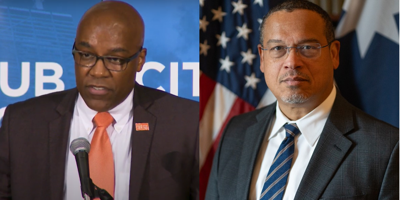



From left, Illinois Attorney General Kwame Raoul and Minnesota Attorney General Keith Ellison
MINNEAPOLIS - As a federal judge in Chicago prepares to hear Illinois' and Chicago's lawsuit seeking to all but halt ICE and Border Patrol immigration enforcement actions in the state, a Minnesota federal judge has ruled a nearly identical legal action brought by that state and its largest cities will likely fail as an unconstitutional attempt to use the courts to give states veto power over federal immigration enforcement.
On Jan. 31, U.S. District Judge Katherine M. Menendez rejected the attempt led by Minnesota Attorney General Keith Ellison to win a court order forcing the White House to withdraw thousands of immigration enforcement agents from Minneapolis and other areas of Minnesota.
The decision effectively ensures that U.S. Immigration and Customs Enforcement (ICE) and Border Patrol can continue its ongoing Operation Metro Surge. The massive immigration enforcement operation involving thousands of federal agents has been ongoing for weeks. Federal officials have said the operations came in response to a call to investigate claims of massive fraud worth billions of dollars committed by illegal immigrants in Minneapolis, and particularly those from the city's prominent Somali immigrant community.
The enhanced enforcement operations have generated organized resistance, protests, interference and riots, spearheaded by activists and encouraged by state and local government officials in Minnesota, who claim the federal campaign of raids, arrests and deportations violate the constitutional rights of immigrants and U.S. citizen protestors and resisters.
At least two U.S. citizens, Renee Good and Alex Pretti, have been killed by agents amid the turmoil, generating still more outrage and protests.
But the conflagration in Minnesota is only the latest flash point over immigration enforcement in the U.S., coming on the heels of similar resistance, including protests and violence directed at federal agents, in Illinois, California and other Democrat-led states and cities.
Democrats, led by governors, including JB Pritzer in Illinois and Tim Walz in Minnesota, and the mayors of major cities, including in Chicago, Los Angeles and Minneapolis, among others, have steadfastly opposed all efforts by the federal government to arrest and deport illegal immigrants.
This has led President Donald Trump and others in his administration to accuse them of encouraging insurrection and lawlessness.
However, in mid-January, Ellison and his Democratic counterpart in Illinois, Attorney General Kwame Raoul, simultaneously filed virtually identical lawsuits seeking to bring such immigration enforcement to an end in their states.
In the lawsuits, they assert it is Trump and ICE and Border Patrol agents who are the criminals against whom the court must take action.
In the Illinois lawsuit, for instance, Raoul's office, joined by the city of Chicago, assert Trump and the federal immigration enforcement agencies have "unleashed an organized bombardment" on Illinois and Chicago, "causing turmoil and imposing a climate of fear."
They assert the agents have acted "lawlessly" in Illinois and Chicago, allegedly sending "uniformed, military-trained personnel, carrying semi-automatic firearms and military-grade weaponry," who have "unleased sweeping raids and indiscriminate violence against Illinois' residents," while "stopping, interrogating, and arresting residents, and attacking them with chemical weapons," typically tear gas or pepper spray.
Raoul and Ellison argue the actions were not designed to enforce immigration laws, but rather to force Democrats in Illinois and Minnesota to end their states' sanctuary policies and to stop defending and shielding illegal immigrants.
The lawsuits assert the enhanced federal immigration enforcement operations amount to illegal federal invasions or occupations and violate the state sovereignty of Illinois and Minnesota under the Constitution's Tenth Amendment.
They further argue the attempted "coercion" further violates the so-called anti-commandeering doctrine which courts have generally ruled prohibit the federal government from forcing states to use state resources to enforce federal law.
To date, U.S. District Judge Sara Ellis in Chicago has not yet heard arguments in the Illinois case.
However, in Minnesota, Ellison's office sought an injunction to attempt to bring a quick end to immigration operations in Minnesota. That advanced the case to a preliminary decision more quickly.
In response to the lawsuit, the Justice Department argued Minnesota's lawsuit - and perhaps, by extension, Illinois' nearly identical claims - amount to an unconstitutional effort to give Democratic governors and attorneys general the ability to "veto" federal immigration enforcement operations and perhaps other federal law enforcement initiatives with which they disagree politically.
In her ruling, Menendez, an appointee of former President Joe Biden, did not directly address the merits of the competing legal claims.
And she said she shared many of the state of Minnesota's concerns over federal operations and tactics amid Operation Metro Surge.
However, she still denied the injunction, saying she didn't believe Minnesota could win their case.
Specifically, she said the Constitution does not allow Minnesota or other states to seek to use so-called "state sovereignty" claims to thwart Operation Metro Surge or other immigration enforcement operations.
Menendez further rejected Minnesota Democrats' attempt to argue the recent surge in immigration enforcement operations in and around Minneapolis amounts to unconstitutional coercion.
She said courts have made clear the federal government is allowed to "pressure" states to fall in line with federal goals and priorities. And Menendez said she wouldn't issue an injunction against the federal government in this case, when the line is not at all clear where "pressure" ends and unlawful "coercion" begins when dealing with a clear federal legal prerogative like immigration.
Minnesota Democratic officials "have provided no metric by which to determine when lawful law enforcement becomes unlawful commandeering, simply arguing that the excesses of Operation Metro Surge are so extreme that the surge exceeds whatever line must exist," Menendez wrote. "A proclamation that Operation Metro Surge has simply gone 'so far on the other side of the line' is a thin reed on which to base a preliminary injunction."
Menendez further rejected Minnesota's assertion that the decision by the White House to flood Minneapolis with agents, rather than in other states with more illegal immigrants, demonstrates an unconstitutional violation of state sovereignty.
Menendez said judges could "reasonably" conclude that Minnesota officials could have no one to blame for the enhanced enforcement operations than themselves, as their "sanctuary" policies and refusal to cooperate with federal authorities could "require a greater presence of federal agents to achieve the federal immigration enforcement objectives than in a jurisdiction that actively assists ICE."
In response to the decision, Ellison, for his part, said he was "fighting on" despite the ruling. He asserted the case is in its "infancy ... with much legal road in front of us."
And he further applauded and called for more resistance to federal immigration operations in his state and elsewhere.
The Minnesota decision is not binding in Illinois. And Judge Ellis has not indicated how she may rule in the case.
However, the legal arguments advanced in both cases are virtually identical, and it is expected the Justice Department's response to Illinois' claims will also be similar, if not identical.
So the ruling could offer a preview of an uphill battle Raoul and his fellow Illinois Democrats may face in using those arguments to secure their desired immediate and sustained end to the federal immigration operations that have roiled Chicago and other communities in Illinois for nearly a year.