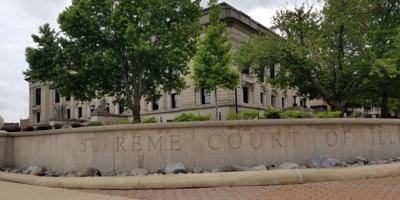


Illinois Supreme Court, Springfield, Ill.
CHICAGO — Saying to find otherwise would leave him with no option other than to allow the justices of the Illinois Supreme Court — the very people he is suing — to control the fate of his case, a former Cook County judge has asked a federal appeals court to carve a path forward in federal court for his claims that Illinois' top state court judges trampled his personal and professional rights by abruptly ousting him for supporting President Donald Trump.
On July 20, attorneys for former Cook County Judge James Brown filed their opening brief in their appeal of a Chicago federal judge's ruling, effectively blocking Brown, for now, from using federal courts to sue Illinois' state Supreme Court justices and seek an order forcing them to reinstate him to the Cook County Circuit Court and to pay him for their alleged unconstitutional actions.
In the appeal to the U.S. Seventh Circuit Court of Appeals, Brown's team argued the ruling from U.S. District Judge Edmond Chang, finding he must abstain from interfering in Illinois state court matters, effectively left the former judge with no fair judicial forum in which to press his claims.
"The district court (Judge Chang) abused its discretion by abstaining under circumstances that satisfy none of the traditional requirements of abstention doctrine," Brown's lawyers wrote in the July 20 brief. "Abstention presupposes 'the opportunity to raise and have timely decided by a competent state tribunal the federal issues involved.'
"Judge Brown has no such forum," they said.
The appeal comes as the latest step in the heated legal fight that began in February, shortly after the Illinois Supreme Court abruptly ousted Brown from the bench, just a few weeks after appointing him to a temporary assignment in the Cook County Circuit Court.
In his lawsuit, Brown accused the Democrat-dominated state high court of violating his official rights as a judge and his constitutional speech rights as a citizen, by weaponizing Illinois' judicial conduct code against him to suppress his speech and punish him for supporting Trump.
Brown has asked the federal court to order the Illinois Supreme Court to reinstate him and potentially pay him damages for their alleged constitutional overreach.
Brown had retired from the Cook County Circuit Court in 2020, after 18 years on the bench.
However, the Illinois Supreme Court recalled Brown to active service five years later, appointing him to a temporary assignment on Cook County's traffic courts in December 2025.
According to the Illinois Supreme Court at the time, Brown's temporary appointment was needed to help Cook County's overburdened courts deal with a shortage of judges amid a crush of backlogged cases.
However, in January 2026, the court suddenly decided to retract that assignment, amid a public pressure campaign mounted by Chicago Democrat lawyers.
At least two legal organizations, including the Cook County Bar Association, which represents the interests of black lawyers and judges in Chicago, and the Chicago Council of Lawyers issued statements and sent letters to the Illinois Supreme Court demanding the court rescind Brown's appointment.
In those communications, the organizations claimed Brown had demonstrated himself to be unfit to hear cases in Cook County due to bias. As proof, they pointed to a column Brown published in an online publication operated by former Chicago Tribune columnist John Kass in September — four weeks before he applied for the judicial recall.
In that column, titled "His Judgment Cometh, and That Right Soon," Brown assailed what he called "lawfare" waged by Democratic activists and politicians in Illinois and elsewhere in the U.S. against President Donald Trump and his supporters.
He further singled out for criticism the controversial criminal prosecutorial and policy decisions of former Cook County State's Attorney Kim Foxx and other prosecutors, who Brown agreed had been propped up by billionaire left-wing activist George Soros and his political organizations to advance left-wing criminal justice reforms in Chicago and nationwide.
The complaining legal organizations asserted the column — which Brown authored and published when he was no longer a judge and before his recall — amounted to violations of the Illinois Code of Judicial Conduct, which require judges to "promote public confidence" in the courts.
The groups asserted the column was "wildly inappropriate for a member of the judiciary to be making" and showed Brown lacked "the temperament, judgment, independence, competence, impartiality and respect for the rule of law necessary for those who serve in the judiciary."
After receiving the complaints from the lawyer associations, the Illinois Supreme Court then declared Brown's appointment had been rescinded and he was removed from the bench.
Brown has argued the Illinois Supreme Court lacked the constitutional authority to remove him, because the Illinois state constitution gives only the Illinois Courts Commission the authority to remove judges related to ethical violations or other alleged misconduct, following a full investigation and hearings at which accused judges are allowed to defend themselves.
In this case, Brown said, he was provided none of those required opportunities.
In response, the Illinois Supreme Court argued the justices had the authority to remove Brown because the justices merely "ended his recall assignment." They asserted the protections normally accorded to judges by the state constitution shouldn't apply to Brown in this case.
In their motion to dismiss, the Illinois Supreme Court justices asserted Brown's ouster was justified because Brown's pro-Trump column violated Illinois judicial conduct rules, even though he wasn't a judge at the time he wrote it. They further argued Brown's pro-Trump statements made him unfit to serve as a judge hearing cases in heavily Democratic Cook County, even in cases involving traffic tickets.
On June 1, Chang ruled on the Illinois Supreme Court justices' dismissal request.
In that ruling, Chang agreed Brown had a likely chance of succeeding in pressing his claims that the state Supreme Court had violated at least his professional rights to due process, as a judge.
Chang was less certain on Brown's likelihood of success in pressing his claims that the state high court violated his First Amendment speech rights.
But Chang said, regardless, he believed he may be barred from handling the case at all, noting the Seventh Circuit court has previously ruled that federal district judges lack the authority to intervene in legal disputes over how state courts conduct their operations and must abstain in such cases.
Without a ruling from the Seventh Circuit explicitly exempting Brown's case from that general rule requiring district courts to abstain in such disputes, Chang said Brown must, perhaps ironically, turn to the Illinois state courts to handle his claims.
Chang particularly directed further briefing on the question of whether Brown's case belongs in either Illinois state courts or the Illinois Court of Claims, a special, quasi-judicial body established to handle lawsuits and financial demands against state agencies.
In his new appellate brief, however, Brown asserts such direction would leave him all but locked out of a fair court.
He argued the Illinois Court of Claims, which functions as an administrative agency, has no jurisdiction to hear his constitutional claims.
And Brown said Illinois state courts are "overflowing with bias," as state court judges ultimately answer to the very Illinois Supreme Court justices who Brown is suing. And if his case is forced into Illinois state court, Brown said, those same justices would "ultimately sit in judgement of their own unconstitutional actions."
"... Federal court is the only place where Judge Brown can seek remedy for the violations of his First and Fourteenth Amendment rights," Brown said.
Brown is represented in the action by attorneys Brendan J. Philbin and Jeffrey M. Schwab, of the Liberty Justice Center, of Washington, D.C.
The Illinois Supreme Court has not yet responded in the Seventh Circuit to Brown's appellate brief.