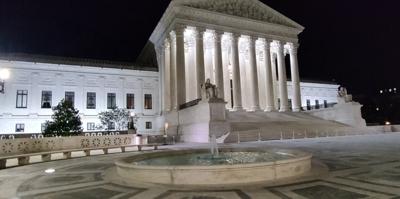



U.S. Supreme Court
WASHINGTON — Organizations representing thousands of sheriffs across the U.S. are urging the U.S. Supreme Court to strike down so-called "assault weapon" bans in Cook County and throughout the country.
On Aug. 31, the National Sheriffs Association, together with the Western States Sheriffs Association, filed a brief with the high court, siding with Second Amendment rights advocates and gun owners in their fight to roll back efforts by Illinois and other Democrat-dominated states and local governments seeking to ban the sale and possession of a long lists of popular semiautomatic firearms.
In the brief, the sheriffs' groups argue restrictions on the ownership imposed by states and local governments not only violate the Second Amendment's protections of the right to keep and bear arms, but also encourage criminal activity, including violent crime.
"Law enforcement officers cannot be everywhere at once and cannot automatically appear instantaneously at the scene of the crime," the sheriffs wrote in their brief.
"Response times may vary from a few minutes to half an hour depending on manpower and geographical area. And a violent crime, especially a home invasion, can occur in seconds.
"The only viable option for an innocent citizen to have immediate protection is to have a weapon for self-defense," they wrote.
The filing landed as one of what is expected to be a massive number of briefs filed at the Supreme Court, as justices prepare for arguments later this year over the fate of bans on so-called "assault weapons," and particularly the semiautomatic rifle known as the AR-15 and similar firearms.
In June, the U.S. Supreme Court agreed to take up an appeal challenging a local ban on AR-15s and similar semiautomatic weapons imposed by Cook County, as well as a state-level ban on such guns imposed in Connecticut.
Both challenges were lodged by the Second Amendment Foundation (SAF).
The SAF and other Second Amendment rights advocates hope the Supreme Court's decision to at last take up cases addressing such gun bans means the high court will end a growing list of other laws in Illinois and elsewhere pushed primarily by Democrats that they say trample Second Amendment rights.
The Cook County case is just one of several legal challenges to so-called "assault weapons" bans raging in courts across the country.
In Illinois, for instance, the courts have wrangled over the constitutionality of Illinois' statewide gun ban, dubbed by supporters as the "Protect Illinois Communities Act," since it was enacted in 2023.
The law includes several provisions banning a long list of semiautomatic firearms and so-called "large capacity magazines," which the state defined as ammunition magazines which can hold more than 10 rounds.
Democratic state lawmakers and Gov. JB Pritzker passed the law in 2023, in direct response to the massacre at the 2022 Fourth of July parade in suburban Highland Park. The attack was carried out by a lone gunman wielding a semiautomatic rifle manufactured by Smith & Wesson, which the state has included on a list of so-called "assault weapons" Illinois Democrats believe should be banned in the state.
Second Amendment rights supporters, however, say the law is a blatant violation of the Second Amendment, particularly as interpreted by the U.S. Supreme Court in two decisions, New York State Rifle & Pistol Association v Bruen and the earlier landmark Second Amendment decision, District of Columbia v Heller.
The Cook County ordinance predates the Illinois law and in some ways served as the model for the constitutionally questionable law. The county first banned certain semiautomatic weapons in 1993. But the ordinance was strengthened and lengthened in the years since to ban a longer list of firearms and so-called "large capacity magazines."
The ordinance has also been the subject of long-running legal challenges.
To this point, courts in Illinois, in particular, mostly have sided with the state and Cook County.
For the most part, judges, including at the U.S. Seventh Circuit Court of Appeals and other appeals courts, have ruled that the banned weapons are not "arms" protected by the Second Amendment, because the courts say states and other governments have the authority to ban weapons they believe are overly dangerous or too closely related to military-style weaponry.
One federal judge in Illinois, U.S. District Judge Stephen McGlynn in southern Illinois, has ruled the law unconstitutional. That ruling, however, was overturned again by the Seventh Circuit on appeal.
There, a 2-1 majority of a three-judge panel again said in July that Illinois Democratic lawmakers can still ban AR-15s and other "assault weapons" if they wish, so long as lawmakers determine the weapons they wish to ban are "unusually dangerous" or "capable of unprecedented lethality."
In their brief to the U.S. Supreme Court, the sheriffs associations took issue with such characterizations of the banned weapons.
The sheriffs said AR-15s and similar weapons are no more dangerous than any other semiautomatic weapons, which fire one round per pull of the trigger.
Further, the sheriffs said the weapons at the heart of the dispute can be essential to the ability of homeowners and others to defend themselves and their families against violence.
"Law abiding citizens with an AR-15 are not a threat to anyone," the sheriffs said. "Millions of Americans own such weapons for self-defense and have a Second Amendment right to do so.
"When we disarm law-abiding citizens, we make them vulnerable. Banning law abiding citizens from having AR-15 type rifles will do nothing to keep weapons out of the hands of violent criminals.
"Such a ban will only disarm innocent victims who need protection."
The sheriff associations are represented before the U.S. Supreme Court by attorneys Gregory C. Champagne and Maurice E. Bostick, of the St. Charles Parish Sheriff's Office, of Luling, Louisiana.
Attorneys for neither Cook County nor the state of Illinois have yet filed a response or a brief in the case before the Supreme Court.
The U.S. Supreme Court has not yet set a date for oral arguments in the case. However, it is expected the arguments could take place in October.