





Illinois Gov. JB Pritzker, flanked by Illinois Senate President Don Harmon, left, and House Speaker Emanuel "Chris" Welch, right
CHICAGO — Even as the U.S. Supreme Court signals such gun bans may be on borrowed time, a federal appeals court has ruled Illinois' ban on so-called "assault weapons," and particularly the AR-15 rifle, should yet survive, because the weapons it bans are too "dangerous" and deadly.
A divided three-judge panel of the U.S. Seventh Circuit Court of Appeals ruled 2-1 on July 9 that the Illinois law banning the ownership of a long list of so-called "assault weapons" and the ammunition magazines needed to make them work is constitutional.
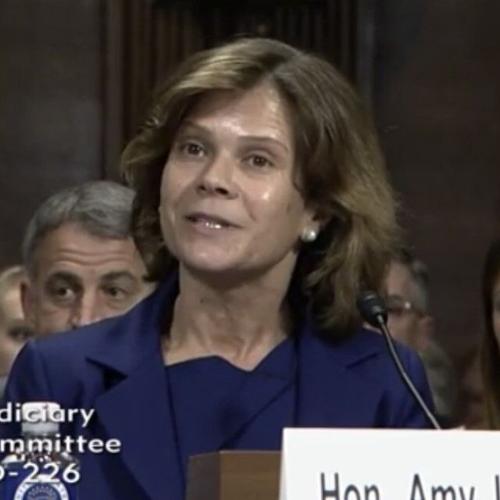
The ruling was authored by Seventh Circuit Judge Amy J. St. Eve, joined by Circuit Judge Frank Easterbrook.
The third member of the panel, Seventh Circuit Chief Judge Michael Brennan, dissented.
St. Eve and Brennan are each first-term appointees of President Donald Trump. Easterbrook has served on the court since 1985, when he was appointed by former President Ronald Reagan.
The ruling marks the latest step in the long-running, roiling and so far unsuccessful efforts by gun owners and Second Amendment rights advocates to strike down Illinois' gun ban regime.
Legal challenges o the so-called Protect Illinois Communities Act (PICA) began almost immediately after Gov. JB Pritzker signed the legislation into law in 2023. The law took effect on Jan. 1, 2024.
The PICA law includes several provisions banning a long list of semiautomatic firearms and so-called "large capacity magazines," which the state defined as ammunition magazines which can hold more than 10 rounds.
Pritzker and other supporters of law say it is needed to prevent future mass shootings. Democrats rammed the law through the General Assembly in response to the massacre at the 2022 Fourth of July parade in suburban Highland Park. The attack was carried out by a lone gunman wielding a semiautomatic rifle manufactured by Smith & Wesson, which the state has included on a list of so-called "assault weapons" Illinois Democrats believe should be banned in the state.
Second Amendment rights supporters, however, say the law is a blatant violation of the Second Amendment, particularly as interpreted by the U.S. Supreme Court in two decisions, New York State Rifle & Pistol Association v Bruen and the earlier landmark Second Amendment decision, District of Columbia v Heller.
In those decisions, the Supreme Court created tests for states and courts to use when evaluating if such restrictions are constitutional. Those tests require courts and lawmakers to evaluate if the weapons being banned are both dangerous and unusual, and if the restrictions are in keeping with U.S. history and tradition dating back to the ratification of the Second Amendment in 1791 and the Fourteenth Amendment in 1868.
Despite those Supreme Court rulings, attempts to block the law have failed to this point.
In Chicago federal court, district judges repeatedly refused to block the law.
And at the Seventh Circuit, Easterbrook and his former colleague, Judge Diane Wood, backed up those decisions, saying they did not believe the Second Amendment protects the banned weapons at all, because those weapons are too dangerous and too closely resemble military-grade weaponry.
However, that reasoning was rejected by southern Illinois District Judge Stephen McGlynn, who ruled Illinois' law is prohibited under the tests established under Bruen and Heller. That decision was appealed to the Seventh Circuit in 2025, setting up the new ruling.
In the new majority ruling, St. Eve, who replaced Wood upon her retirement, together with Easterbrook, notably now abandoned Easterbrook's earlier findings AR-15s and other weapons banned by Illinois' law didn't qualify as "arms" protected by the Second Amendment.
Neither St. Eve nor Easterbrook explained the decision to contradict the earlier ruling, saying they would now "presume" the weapons now qualify as "arms."
However, in the new ruling, St. Eve and Easterbrook said Illinois Democratic lawmakers can still ban AR-15s and other "assault weapons" if they wish, so long as lawmakers determine the weapons they wish to ban are "unusually dangerous" or "capable of unprecedented lethality."
St. Eve and Easterbrook particularly harped on the ability of lone shooters to use the weapons to inflict mass casualties, such as occurred during the massacre at the 2022 Highland Park Fourth of July Parade and other so-called "mass shootings."
Further, the judges downplayed the weapons' use in self-defense, agreeing with the state that banning entire categories of firearms doesn't burden Illinoisans' Second Amendment rights too much, because Illinois residents are still free to buy other weapons, such as handguns or shotguns not otherwise banned under the Illinois state law.
And St. Eve and Easterbrook rejected completely arguments that the gun ban should be struck down because many Illinoisans already "commonly own" America's most popular semiautomatic rifle, the AR-15 and similar firearms.
In support of this contention, they pointed to one prime historical analog: laws in various places in the U.S. in the 1800s prohibiting people from carrying Bowie knives. While those weapons were "commonly owned" by many Americans at the time, the judges said states moved to strictly limit their use, because the knives were too dangerous and highly lethal.
That, the judges said, should mean states, like Illinois, can now ban entire classes of firearms, no matter how many people own them.
Because Illinois lawmakers have determined AR-15s and other weapons banned by the PICA law are more "dangerous" than other kinds of commonly owned guns, and particularly because mass shooters appear to prefer those kinds of guns when carrying out horrific massacres, then courts can adopt a "more nuanced approach" and allow states to ban them without violating the Second Amendment.

U.S. Seventh Circuit Judge Amy J. St. Eve
"In short, whatever else may be contributing to America’s mass-shooting epidemic, the record makes one thing clear: The more people killed, the more likely it is that the killer used an assault weapon and large-capacity magazines," St. Eve wrote.
In dissent, however, Brennan said such legal determinations based on the desired ends of politicians have already been foreclosed by prior U.S. Supreme Court rulings.
He noted the decision all but ignores the Supreme Court's directives in Bruen and Heller in support of the overarching goal of banning "dangerous" weapons.
"Whether a firearm is useful for self-defense is not a decision for judges," Brennan wrote.
Brennan further assailed the majority’s contention that past laws regulating the carry of Bowie knives now means Illinois and other states can simply ban any weapons they find “overly dangerous.”
Brennan, for instance, noted that the only state law attempting to completely ban possession of Bowie knives, out of Georgia, also in the 19th Century, was struck down as unconstitutional infringement of the right to keep and bear arms.
“Illinois has many options for stopping or limiting these horrendous attacks. But the enshrinement of constitutional rights 'necessarily takes certain policy choices off the table,'" Brennan wrote, citing Heller.
"That includes taking millions of AR-15s out of the hands of law-abiding citizens. The waxing, or we pray the waning, of societal problems does not amend the scope or effect of the Second Amendment."
However, the Seventh Circuit's new decision is almost certainly not the final word on the ultimate fate of Illinois' gun ban law.
The U.S. Supreme Court has already agreed to take up two cases, including one dealing with an "assault weapons" ban long on the books in Cook County, to perhaps finally decide if governments can ban AR-15s and other semiautomatic weapons in the name of protecting the public.
The Supreme Court is expected to render a decision on that question in its next term, beginning in the fall and ending in June 2027.
And the outlook for such gun bans at the Supreme Court is questionable, at best.
Until taking the Cook County case and another challenge to a gun ban in Connecticut, the Supreme Court had declined to step in on the question, despite challenges to similar laws in several Democrat-dominated states.
However, in the past two years, some justices on the high court had warned that findings like those reached in the Seventh Circuit may not ultimately hold up under scrutiny.
Justice Clarence Thomas, for instance, notably called the Seventh Circuit's earlier reasoning justifying Illinois' gun ban "nonsensical," "contrived" and "highly suspect."
And Justice Brett Kavanaugh also signaled his skepticism over the constitutionality of such gun bans in 2025, calling a similar ruling out of the Fourth Circuit Court of Appeals upholding a similar "assault weapons" ban in Maryland "questionable."
At the time, Kavanaugh predicted the Supreme Court would address such rulings "soon."