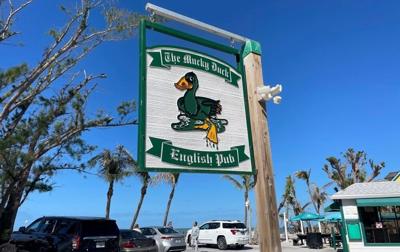


The Mucky Duck on Captiva Island
FORT MYERS, Fla. – The Captiva Erosion Prevention District, which recently requested a state lawsuit filed against it by the iconic Mucky Duck restaurant on Captiva Island be moved to federal court, now wants the suit dismissed altogether.
The Mucky Duck filed its lawsuit in December against the CEPD in the Circuit Court of the Twentieth Judicial Circuit in Lee County. Last month, CEPD requested the lawsuit be moved to the U.S. District Court for the Middle District of Florida, Fort Myers Division.
The beachfront restaurant – known for its sunset views – alleges CEPD illegally built a 12-foot artificial dune barrier. It claims the district’s involvement in managing and overseeing coastal protection efforts resulted in constitutional violations, and construction of the barrier turned the “vibrant landscape” into a “desolate appearance of the moon” and rendered its patio useless.
The CEPD, an independent special beach and shore preservation district established in the 1950s, argues in its Jan. 28 motion to dismiss that the plaintiff’s allegations are “conclusory, speculative, and impermissibly vague.”
“Plaintiffs allege that the District’s actions led to harmful regulatory decisions, which were then compounded by the District’s ensuing beach nourishment project that impacted the Plaintiffs’ property interests, effectively causing a de facto taking without just compensation, depriving Plaintiffs of protections afforded by the Constitution,” the district’s 19-page motion states.
“However, Plaintiffs’ Complaint fails to provide specific, factual allegations demonstrating how the District’s conduct or policies led to Plaintiffs’ alleged violation of their Constitutional rights. Instead, Plaintiffs’ claims are overly generalized and are made without adequate factual support necessary to establish a plausible link between the District’s actions and the alleged harm suffered by Plaintiffs.”
The CEPD contends the same allegation is “repackaged” into multiple separate counts. In addition, the district argues the restaurant’s complaint does not allege any facts that show its actions led to the “permanent appropriation” of the restaurant’s property or complete deprivation of economic use.
“Far from it,” the motion states. “The Mucky Duck Restaurant continues to operate and Plaintiffs do not claim, within their Complaint, permanent appropriation. Instead Plaintiffs seek to create a substantial interference claim solely through allegations the view from the Patio of the Restaurant is now different than it was before the barrier was constructed.
“Plaintiffs only claim is that the barrier ‘damaged’ their property, but this assertion is again conclusory, lacking any factual support.”
Specifically, the CEPD contends the restaurant’s complaint fails to include any facts supporting the extent of interference caused by the barrier, or exactly how the alleged interference permanently deprived Mucky Duck of its ability to use or economically benefit from its restaurant.
“In order to succeed, Plaintiffs must allege that the government reached a final position on the permanence of the barrier and the permanence of the impact on the Plaintiff’s property, not the construction of a barrier which may necessarily change over time and may be meant to change through impermanence due to the fact that beach conditions drastically change on the Florida coastline due to weather conditions,” the district’s motion states.
The CEPD argues the allegation that the construction of the dune barrier affected the restaurant’s views or access to their property is “insufficient” to show a protected property interest under the law.
“Humans rely on property rights and this reliance cannot be arbitrarily undermined. However, when a property interest lies on an ever-changing shoreline, subject to a ‘taking’ by mother nature through hurricanes and storm surges, the government must necessarily be able to act to buttress parts of it on short notice,” the district’s motion states. “In this context, procedural due process does not require advance notice or individualized hearings before the government undertakes protective, statutorily prescribed action to stabilize an inherently dynamic shoreline.
“Due process cannot be read to paralyze government action in the face of constant storms in which erosion control measures must be quickly implemented before the integrity of large swathes of coastline is compromised, potentially costing the state of Florida and taxpayers tens of millions of dollars more than necessary to make repairs on a collapsed shoreline, rather than prevent it.”
The CEPD continues, “The government must be able to prevent shoreline collapse for these reasons and has been given statutory authority to do so.”
The district notes that Florida is a “turbulent state,” weather wise, and governmental authorities such as itself must be free to protect the beach from storms and erosions.
“While it is unfortunate for Plaintiff that the efforts undertaken by Plaintiff allegedly change the nature of the view from the patio, the language of the statute is clear in the delegation of duties to the District,” its motion states. “The construction of the barrier was undertaken because the District has a statutory responsibility to protect the beach in front of the Mucky Duck Restaurant.”
The district argues it is simply carrying out the duties prescribed to it.
“Plaintiffs cannot establish that while a project that succeeds in helping Plaintiffs keep their restaurant from being washed away by a storm surge actually substantially interferes with their enjoyment of it,” the motion states.
The CEPD filed its seven-page removal notice Jan. 22.
It argued in its notice that the lawsuit belonged in federal court because it includes a federal question – specifically that the district allegedly violated the restaurant’s federally protected civil rights.
The firm of Roberts Reynolds Bedard & Tuzzio PLLC, with offices in West Palm Beach and Fort Myers, is representing the CEPD in the action.