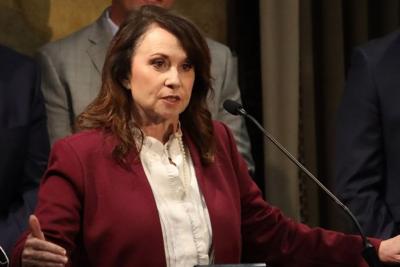


Louisiana Attorney General Liz Murrill
BATON ROUGE – Louisiana Attorney General Liz Murrill has announced a multistate settlement with Block, the company behind the peer-to-peer payment app Cash App.
The $45 million national settlement resolves allegations that Block misled consumers about Cash App's safety, failed to protect users from fraud and didn't provide the fraud protection and resolution it promised and that the law requires. Louisiana will receive $557,086.81.
"Cash App promised consumers a safe way to send and receive money, but too many Louisianans were left on their own when fraud occurred,” Murrill said. “Companies that handle people's money have a responsibility to protect their customers and follow the law. If they don't, we will hold them accountable.”
Block told users their money was safe and implied Cash App worked like a bank. Murrill and other AGs said that wasn't true.
As fraud on the platform increased, the AGs said Block continued marketing the app – including pushing direct deposits of paychecks and government benefits to unbanked and underbanked consumers who were especially vulnerable to fraud – without ensuring it could support those users when problems arose.
The AGs say investigators found Block’s own practices made fraud easier. They said Block’s sign-up process was fast and frictionless, requiring minimal identity verification. They also say Cash App offered no phone support for years, leaving users to find fake customer service numbers run by scammers who then drained their accounts.
Additionally, a social media promotion called Cash App Fridays, which encouraged users to publicly post their $cashtag for a chance at a prize, became a tool scammers used to steal login credentials – a scam Block knew about but let continue for years, according to the AGs.
Under the settlement, Block must maintain customer support able to resolve fraud complaints and lockouts, offer live support 24 hours a day – with phone availability at least 13.5 hours a day and live chat at least 18 hours a day, stop misleading claims about Cash App’s safety, discontinue marketing practices known to increase fraud, educate consumers about common scams and fulfill its legal duty to investigate fraud claims and reimburse victims.
The settlement also reaffirms Block’s commitment, under a related CFPB settlement, to distribute between $75 million and $120 million to consumers nationwide. Oregon and Texas led the investigation, securing relief for all 46 participating states.
* * *
Murrill and 48 other AGs are calling on the Federal Communications Commission to strengthen rules that would cut off scammers’ access to legitimate telephone numbers.
Without that access, the AGs say scammers can’t use real numbers to deceive and scam Americans.
The Anti-Robocall Multistate Litigation Task Force asked the FCC to work on this issue in 2021, and members of this coalition are now responding to the FCC’s proposed rules.
“I’m one of the many Louisianans who are sick and tired of robocalls constantly harassing and attempting to steal people's money, identity and private information,” Murrill said. “We need to make it harder for scammers to exploit legitimate phone numbers and easier for law enforcement to trace these scams back to the source.
“I’m proud to join my fellow attorneys general in pushing for stronger protections that will help stop these scams and protect Louisiana consumers.”
Last year, Americans received approximately 29.6 billion scam robocalls and texts and lost nearly $2 billion to these scams. Scammers used to illegally “spoof” phone numbers to make it look like a call was coming from a legitimate company or government agency. But scammers can’t easily do this anymore after the federal government and state attorneys general took action to cut down on illegal spoofing.
Now, scammers often purchase legitimate phone numbers and use them to make robocalls. While most legitimate businesses use the same phone number for many years, scammers cycle through millions of brand-new phone numbers, which helps them avoid detection by spam filters.
In addition to the steps the FCC is already taking, the bipartisan attorneys general are asking the federal government to do more, including:
· Require every company that is authorized to purchase and then resell phone numbers in North America to meet stronger certification rules and share how and to whom they are assigning numbers.
Require these companies to submit regular reports about the sale and use of numbers, so law enforcement can trace illegal robocalls back to the source. These reports will also help law enforcement hold all the companies in the call path accountable for selling or transmitting numbers used to conduct illegal robocalls.
Require people and entities that are applying to access phone numbers to confirm that they won’t use them to make illegal robocalls.
Block the sale of phone numbers to entities that aren’t tied to a calling or texting service. Robocallers often buy these numbers without linking them to a legitimate phone service, since they don’t plan on using the numbers for legitimate calling and texting purposes.
Prohibit number cycling, which is when an entity buys lots of numbers and then uses them on a rotating, sometimes single-use basis to avoid being detected by tools that flag numbers used to make illegal robocalls.
Restrict the offering of trial numbers to discourage scammers from taking advantage of them to harm consumers.
Murrill is joined in signing the letter by the attorneys general of Alabama, Alaska, American Samoa, Arizona, Arkansas, California, Colorado, Connecticut, Delaware, District of Columbia, Georgia, Hawaii, Idaho, Illinois, Indiana, Iowa, Kansas, Kentucky, Maine, Maryland, Massachusetts, Michigan, Minnesota, Mississippi, Missouri, Nebraska, Nevada, New Hampshire, New Jersey, New Mexico, New York, North Carolina, North Dakota, Ohio, Oklahoma, Oregon, Pennsylvania, Rhode Island, South Carolina, South Dakota, Tennessee, Utah, Vermont, Virginia, Washington, Wet Virginia, Wisconsin and Wyoming. AGs that didn’t join the letter are from Florida, Guam, Montana, Northern Mariana Islands, Puerto Rico, Texas and the U.S. Virgin Islands.