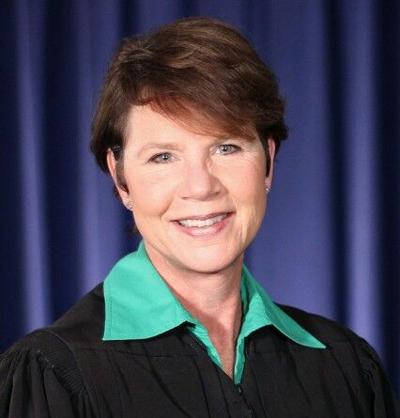


Ohio Supreme Court Chief Justice Sharon Kennedy
COLUMBUS, Ohio – A longtime judge in Ohio did not violate ethics rules when he used his personal Facebook account to support his son’s political career, the Ohio Supreme Court has ruled in a case that affects all judges in the state.
John William Rudduck should face no penalty for endorsing son Brett’s 2023 run for a seat on the Clinton County Municipal Court, the justices held earlier this month. Doing so would violate his First Amendment rights, they said, despite calls from the Disciplinary Counsel that said Rudduck’s posts undermined public confidence in the impartiality of the judiciary.
A prohibition in the Code of Judicial Conduct against judges endorsing judicial candidates is unfair and does not serve a compelling state interest, Chief Justice Sharon Kennedy wrote for the majority.
“Judges do not give up their First Amendment right to engage in political speech simply by assuming office,” she wrote.
“While we acknowledge that the State has a compelling interest in maintaining judicial independence, integrity, and impartiality, Jud.Cond.R. 4.1(A)(3) sweeps too broadly and restricts political speech beyond what is necessary to uphold those state interests.”
Rudduck was a judge in Clinton County for 39 years who shared posts his son tagged him in and posts by nonfamily individuals and wrote a response after Brett’s opponent told a crowd at a campaign event that he was the only candidate not related to a judge.
“Vote BRETT RUDDUCK for judge on May 2,” that post concluded. The opponent, David Henry, ultimately won the seat.
Rudduck also posted a four-part essay after Brett’s Facebook account was restricted. That was in response to “horrific things” a person whose foreclosure case before Rudduck led to his eviction had put on social media, Rudduck said.
In June 2024, a complaint against Rudduck was filed over his Facebook activity. It ultimately led the Supreme Court to decide whether rules prohibiting judges from political speech were unconstitutional.
Judges should be allowed to support campaigns, so long as they know doing so will require their recusal in any case involving the parties that subsequently comes before them, the court said.
Justice Patrick Fischer, in a dissenting opinion, warned that judges could endorse candidates for prosecutor then have to recuse themselves in all criminal matters. He also said Rudduck never raised a First Amendment challenge and that the justices took it upon themselves to decide that issue.
“If a majority of the members of this court believe that the judicial anti-endorsement rule should be set aside or modified, then they should follow the court’s process for amending the Code of Judicial Conduct,” Fischer wrote.
“Doing so would not only avoid abdicating our role as arbiter and taking on the role of advocate by raising constitutional issues on behalf of the parties (and ignoring principles of party presentation, judicial restraint, and constitutional avoidance in the process) but would allow for public notice of the proposed amendment and a public-comment period during which any member of the public could weigh in on the proposed amendments.
“Seeking public feedback is an important part of this court’s rulemaking process.”