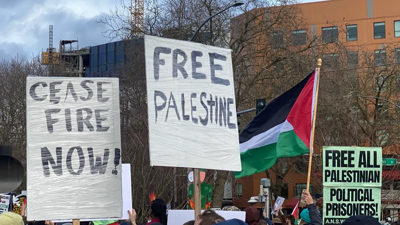



Protesters hold signs reading "Cease Fire Now" and "Free Palestine" along with a Palestinian flag at a demonstration.
CLEVELAND – An Ohio appeals court won’t dismiss a lawsuit brought against Case Western Reserve University by students who were painted over when the school removed a pro-Palestine mural.
The Eighth Appellate District ruled Oct. 15 against the school’s appeal of its unsuccessful motion to dismiss, sending the case back to the Cuyahoga County Court of Common Pleas to play out.
The plaintiffs protested CWRU’s decision to cover the mural, known as the “Spirit Wall,” which was painted May 6, 2024, by students and included phrases like “I dream of breaking the siege” and “come together in peace.”
It also included statistics on the number of child Palestinian deaths since the Gaza war with Israel began. Another mural contained “language the university administration and many members of our community view as threatening, intimidating and antisemitic,” an email from CWRU President Eric Kaler to students said.
The Spirit Wall was “less threatening but still intimidating to some.” CWRU hired companies to paint over both, leading to a gathering of students around midnight that initially stopped the removal.
But the companies returned with CWRU police officers around 5 a.m., which thinned out the group of protestors. Plaintiffs Ameer Alkayali, Weilin Fang and Kevin Kennelly stood in front of the mural in a line, and one cop allegedly told a painter something to the effect of “if they don’t move, it’s on them.”
A YouTube video posted by Cleveland.com shows the painters spraying paint over the three protestors, who wore masks. The video was circulated, leading to another email from Kaler that said, “No students – or any individuals – should ever be treated this way, especially on a campus where our core values center on providing a safe, welcoming environment.”
The lawsuit makes claims for civil assault and battery and was filed by attorney Peter Pattakos. CWRU said in court filings that it was entitled to immunity as a political subdivision, but Cuyahoga judge Mollie Ann Murphy disagreed in November, finding “there exists a potential set of facts that may entitle plaintiff to relief.” CWRU appealed, and the Eighth District concluded CWRU, a private university employing police officers, is not a political subdivision.
“A holding here that CWRU is a political subdivision merely by virtue of the fact that it maintains a police department would mean that every private university in the state of Ohio that likewise maintains a statutorily authorized police department would also be a political subdivision, and the legislature doubtfully intended this in enacting either R.C. Ch. 2744 or R.C. 1713.50,” Judge Timothy Clary wrote.
Judge Kathleen Ann Keough dissented, noting that campus police officers must complete a state training program.
“This indicates that the CWRU police are trained in the same manner that governmental actors are and are trained to further the interests of the state,” she wrote, adding Cleveland has expanded CWRU police authority to include all of the same rights as Cleveland PD when on CWRU property and when traveling to CWRU through Cleveland.
Though she would have found CWRU is a political subdivision, Keough added that a question would have remained whether it was entitled to immunity.