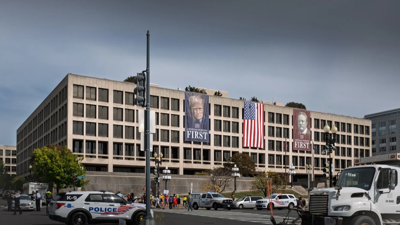


The U.S. Department of Labor building in Washington, D.C., Oct. 18, 2025.
WASHINGTON – The U.S. Supreme Court will decide if a federal agency puts companies through an unfair process of fighting fines, as it today took up a case involving a New Jersey farm forced to shut down after being assessed nearly $600,000 in penalties.
That farm – Sun Valley Orchards – wasn’t given the chance to appeal to federal court after the DOL’s own judges affirmed the punishment. This, it said, violated its Article III right to have the issue heard by an impartial judge in federal court.
Sun Valley’s defense was only heard by administrative law judges within the DOL, and the Supreme Court’s decision to hear the DOL’s appeal of a Third Circuit ruling will let it expand on a 2024 opinion that said the Securities Exchange Commission’s use of ALJs was unconstitutional.
“Small businesses targeted for fines have the right to defend themselves in a real court, with a real judge and jury, rather than an agency court where the only judge is an agency bureaucrat,” said Rob Johnson, senior attorney at the Institute for Justice.
“It’s fundamentally unfair to try a business in a court where everybody involved is employed by the same administrative agency.”
IJ represents Sun Valley and other companies that have gone through the DOL adjudication process. Its brief to the Supreme Court can be found here.
Sun Valley participated in the H-2A nonimmigrant visa program, which allowed it to temporarily hire foreign laborers for seasonal agricultural work. It was alleged to have violated the program's terms, like not offering free housing and transportation, and was ordered to pay back wages because the work ended before the date on the job order.
The Third Circuit found last year that ALJs can be used for proceedings to, for example, remove ineligible workers, which would fall within an immigration exception to preserve the federal government's interest in border control.
But labor code violations concern the feds' interest in domestic wages, it said.
"It is true that portions of the sprawling H-2A program implicate the President's unique power over foreign affairs," wrote Judge Thomas Hardiman, a President George W. Bush-appointee who previously served as a judge in Pittsburgh's federal court.
"But at best, that shows that some H-2A-related actions may proceed in agency tribunals... But the fact that DOL has some authority to proceed in a non-Article III tribunal does not give it carte blanche to do so far all violations."
In representing a Maryland lawn company whose similar fight recently failed but is appealing, IJ said an “entire alphabet soup of federal agencies use in-house agency courts to impose millions of dollars in liability ever year, burdening individuals and businesses across the country.”
In 2024, the DOL Wage and Hours Division ordered $4.9 million in back wages and $5.8 million in penalties in cases similar to Sun Valley’s. The farm is owned by Joe and Russell Marino, who closed it because of the looming financial disaster.