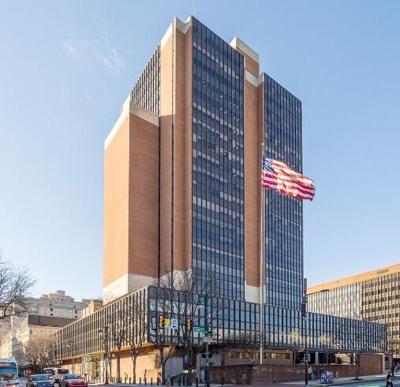


James A. Byrne United States Courthouse
PHILADELPHIA - A South Carolina judge’s attempt to block a New Jersey corporation from filing for bankruptcy is invalid, as are attempts by plaintiff lawyers to sue the company that bought its operations decades ago, a federal appeals court says.
The decision yesterday by the U.S. Court of Appeals for the Third Circuit firmly rebuffs an attempt by South Carolina judge Jean H. Toal to appoint a Columbia personal-injury lawyer as receiver over Whittaker Clark & Daniels, which once sold talc accused of containing cancer-causing asbestos.
Corporations are a creature of state law and even if a South Carolina court thought it could assert control over New Jersey-based Whittaker Clark, “we doubt its ability to do so,” the Third Circuit said.
“Without an order lawfully preventing it from doing so, Whittaker’s board was free to exercise its authority under New Jersey law to enter bankruptcy,” the court said in an April 27 decision.
Toal’s order in South Carolina’s asbestos court essentially put attorney Peter Protopapas in charge of the company. She has adopted the practice of naming him “receiver” of usually defunct companies in order to sue insurers over decades-old policies, which creates a pool of money for asbestos plaintiffs.
But that order is invalid, the Third Circuit says.
“(T)he Order, reasonably interpreted, does not extend so far,” Judge Thomas Ambro wrote. “And if it did, it would be an unprecedented exertion of power over a foreign corporation whose internal affairs are governed by the laws of a sister state, as well as a radical intrusion into the province of a co-equal sovereign.”
The Third Circuit’s ruling adds to decisions by courts rejecting Judge Toal’s attempts to seize foreign and out-of-state corporations to steer their assets toward asbestos plaintiffs in her court. It comes as the South Carolina Supreme Court is considering the case of Altrad Group, a multibillion-dollar U.K. corporation with no operations in South Carolina, which challenges Judge Toal’s attempt to place a receiver over it to pay local asbestos claims.
Whittaker Clark and subsidiaries sold industrial materials including talc, but divested their operations years ago under agreements to retain asbestos liabilities. A unit of Berkshire Hathaway bought the remnants of the company, but its ability to continue paying claims was in jeopardy after it was hit with thousands of lawsuits claiming it sold cosmetic talc contaminated with asbestos.
Sarah Plant won a $29 million verdict against Whittaker Clark in March 2023, and Judge Toal appointed Protopapas receiver “with the power and authority to fully administer all assets.”
Whittaker challenged the order, but at a hearing Judge Toal said she appointed Protopapas because she was worried some “amorphous entity” would put Whittaker Clark into bankruptcy and “would still be controlling things.” The company did just that soon after, filing Chapter 11 in New Jersey.
Protopapas sought to halt the bankruptcy, claiming he had control over the company, but the New Jersey bankruptcy court rejected his authority. Protopapas appealed to federal district court and ultimately the Third Circuit, losing in both.
The Third Circuit noted that receiverships once were a common method for protecting creditors of insolvent companies, but can’t unilaterally reach across state lines. Protopapas could have asked the bankruptcy court in New Jersey to appoint an ancillary receiver to look after the interests of South Carolina creditors but didn’t, the Third Circuit said.
The appeals court also rejected attempts by plaintiff lawyers to sue Brenntag directly for asbestos-related injuries, under a theory of successor liability. Since Brenntag never made the products the plaintiffs are suing over, the court concluded, successor liability claims belong to Whittaker Clark’s bankruptcy estate so any money can be distributed fairly among its creditors.
The South Carolina Supreme Court may trim Judge Toal’s power to appoint receivers over out-of-state corporations in the Altrad case. There, Protopapas claims he controls Altrad, based on the Island of Jersey, even though it has never conducted business in South Carolina and bought a former asbestos mining company decades after it ceased selling the product.
Protopapas has earned millions of dollars in fees under his arrangement with Judge Toal, in which she appoints him receiver over companies with a contract giving him a third of any money he recovers, typically from old insurance policies. He has placed tens of millions of dollars in secret Delaware trusts with sole authority over how to disburse the money.