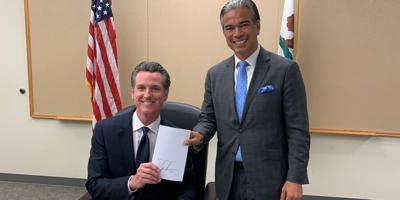



From left, California Gavin Newsom and California Attorney General Rob Bonta
LOS ANGELES — California is accused once again of violating the First Amendment, this time by allegedly attempting to use concerns over public mental health as a back door to assert state control over social media, according to a new lawsuit.
On Oct. 22, NetChoice, an advocacy group representing big tech and social media companies, filed the lawsuit in federal court in Los Angeles against California's state government.
The lawsuit asks the court to block the state from enforcing a new state law which requires a tobacco-style "Surgeon General" warning about the alleged "mental health harms" of social media on digital content accessed by users that the platforms can't verify as adults.
Essentially, the lawsuit asserts the state is attempting to force social media platforms to publish the state's opinions about social media, even when the platform operators disagree, essentially forcing the platform operators to discourage people from accessing content published on their platforms.
And that, they said, is a violation of their constitutional rights to refuse to say what government officials may order them to.
In a statement announcing the lawsuit, Paul Taske, Director of the NetChoice Litigation Center, said: "The First Amendment is not a suggestion. California cannot force a private website to act as a mouthpiece for its preferred message. The State is free to speak for itself, but the Constitution forbids it from forcing others to speak for it."
The lawsuit specifically centers on the new California state law enacted under legislation known as Assembly Bill 56.
AB 56 would require social media platforms to publish a warning whenever content is accessed by users that the platform operators cannot verify are at least 17 years old.
The warning required by the law would read: “The Surgeon General has warned that while social media may have benefits for some young users, social media is associated with significant mental health harms and has not been proven safe for young users.”
The warning would be posted the first time each day those users access each platform, and then "repeatedly throughout the day with increasing frequency." Under the law, the warning cannot be skipped, and must cover at least 75% of the screen for at least 30 seconds.
NetChoice asserts that message, while supposedly expressing the views of the U.S. Surgeon General, remains contested and controversial.
They asserted, for instance, that the warning may not even accurately represent the actual opinion of the Surgeon General, much less fully express the scope of the scientific discussion on the topic.
"Those effects are the subject of intense scholarly and social debate, as well as active litigation. These are contested policy and scientific judgments dressed up as factual warnings and forced into the mouths of private speakers," NetChoice said in its lawsuit.
While courts have upheld the ability of governments to require such "Surgeon General warnings" on addictive and harmful products like cigarettes, NetChoice said this is different. They said the warning labels on tobacco products, for instance, convey factual information about the toxicity and carcinogenic properties of smoking cigarettes.
Further, they said, warning labels on physical products do not intefere with the legal use of the products.
By contrast, they said, the state is requiring social media platform operators to proclaim their product is harmful, when the operators and others actively dispute that claim. And, they said, the warnings are deliberately designed to slow access to social media content, potentially annoying people from accessing the content and, thus, chilling online speech.
NetChoice is represented in the action by attorneys from the firms of Benbrook Law Group, of Newport Beach; and Lehtosky Cohn, of Washington, D.C.
The lawsuit stands as the latest court fight between NetChoice and the state of California over the efforts by California Democrats to regulate social media. The group has scored victories against California over laws to establish state-mandated "privacy protections" for young internet and social media users.
And the group has further challenged California state laws designed to force social media companies to report to the state about how many people under the age of 18 may use their services and to establish measures to restrict minors' access to social media, among other regulations.
California officials have also lost in court to challenges to a state law that sought to give California officials the power to censor and kill online satire videos in the name of fighting "deepfakes" and "misinformation." NetChoice did not sue in that action.
NetChoice, however, did sue in Colorado over that state's social media warning law, which was nearly identical to California's. And NetChoice noted a federal judge has already blocked Colorado from enforcing its law.
"And there is no First Amendment exception for California,” NetChoice's Taske said in his statement.