
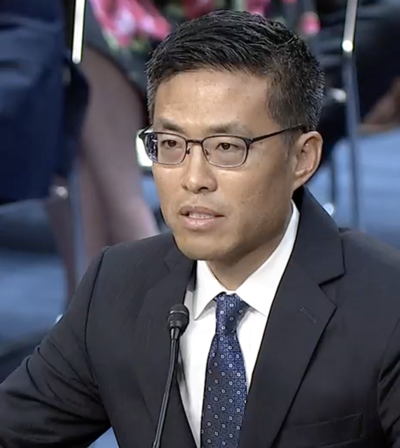


U.S. Ninth Circuit Court of Appeals Judge Eric Tung
SAN FRANCISCO — People living near a federal immigration detention center in Portland, Oregon, don't have a constitutional right to limit when federal officers can use tear gas and other non-lethal crowd control weapons against the often violent anti-ICE protesters have have gathered repeatedly near the federal facility in a bid to disrupt federal immigration law enforcement, a federal appeals court has ruled.
To find otherwise, they said, would essentially allow trial lawyers and their potential clients to use tenuous claims to supposed constitutional rights to "transform the Constitution into 'a font'" of lawsuits.
On April 27, a split three-judge panel of the U.S. Ninth Circuit Court of Appeals knocked down the injunction entered by U.S. District Judge Amy M. Baggio against the U.S. Department of Homeland Security and its immigration enforcement agencies, which had all but prohibited them from using tear gas against protesters in Portland.
In the 2-1 decision, the majority opinion, authored by Ninth Circuit Judge Eric Tung, found Baggio's decision rested on what amounted to an imaginary constitutional right to be free from being exposed to tear gas deployed to safeguard federal officers and property and control public gatherings that had grown violent and unruly.
"Plaintiffs stake their case on the existence of a supposed constitutional right to be free from exposure to tear-gas chemicals used by law enforcement officers as a means of crowd control," Tung wrote. "Their claim fails.
"No such right exists in the Constitution."
Tung was joined in the opinion by Ninth Circuit Judge Kenneth K. Lee. Both Tung and Lee were appointed by President Donald Trump.
Ninth Circuit Judge Ana de Alba dissented.
De Alba and Baggio were both appointed by former President Joe Biden.
The ruling is the latest step in a legal action launched last December by residents of Gray's Landing, an "affordable housing complex" located very near the U.S. Immigration and Customs Enforcement (ICE) facility in Portland's South Waterfront neighborhood.
The residents were represented in the action by attorneys from the firms of Bradley Bernstein Sands, of Portland; and the Jacobson Lawyers Group, of Washington, D.C.
The lawsuit demanded the courts block ICE and other federal agents from using tear gas and other non-lethal munitions against the protesters who routinely gather outside the Portland ICE facility and often have grown violent.
According to court documents and public reports, the demonstrations have at times numbered in the hundreds or thousands, and have included incidents in which protesters have destroyed federal property, threatened officers, brandished weapons, thrown rocks and other objects at officers, blocked the movement of federal law enforcement vehicles moving in and out of the facility, and allegedly attempted to light the building on fire.
The lawsuit, however, asserted the use of tear gas outside the facility was not done with enough care and violates the constitutional rights to "bodily integrity" of people living nearby who are not engaged in the protests, but yet must still be exposed to the chemicals lingering in the air or blown by the wind toward their homes.
Baggio agreed, issuing an order on March 6 she claimed was narrowly tailored to allow ICE agents to "do their jobs safely" but that would still protect the neighboring residents rights to substantive due process and bodily integrity, "the most fundamental aspecst of liberty known since the early days of our democracy."
The order would have blocked federal agents from using tear gas if the chemicals might blow into Gray's Landing, which is as close as 100 feet from the ICE facility.
The federal government, however, argued this amounted to an essential ban on using tear gas and other non-lethal munitions to control crowds and protect the ICE facility from violence and destruction.
On appeal, the panel majority agreed.
They said Baggio's ruling and the plaintiffs' claims could find no support in the Constitution or any legal interpretation to this point.
"The supposed constitutional right at issue has no basis in our nation’s history or tradition." Tung wrote in the majority opinion. "Plaintiffs have not pointed to any historical prohibition—much less a 'deeply rooted' one—against the use of non-lethal crowd-control devices by law enforcement.
"To the contrary, such devices have long been a common tool of law enforcement to disperse crowds that have turned disruptive and violent. As far as we are aware, 'no federal or state court' has recognized the Plaintiffs’ claimed right.
"... Simply put, it does not appear to exist."
The majority ordered Baggio's injunction stayed while the case continues to play out. But they also ordered an end to any further proceedings on the supposed "bodily integrity" substantive due process claims, calling the claims "meritless" and any further discovery on the questions pointless.
In dissent, de Alba didn't assail Tung's point concerning the lack of constitutional support for the supposed rights.
Rather, she asserted the government couldn't show ICE officers were at risk of being harmed by the order, as they theoretically could still use tear gas at the front gate of their facility. She asserted the order only stopped federal officers from deploying tear gas anywhere else that residents not involved in the protests might be exposed to it.
She also asserted the government should be blocked from defeating the order because it waited 10 days after the order was issued to appeal, which de Alba said backed her finding that the government won't be harmed by the restrictions.
The majority, however, rejected those contentions, saying the decision by DHS and ICE to abide by the order for 10 days while they prepared their appeal doesn't foreclose their ability to undo the injunction.
"The lawlessness and risk of an escalation of violence remain," Tung wrote.