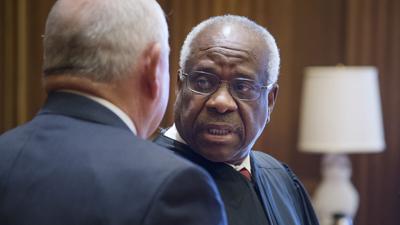


U.S. Supreme Court Justice Clarence Thomas
WASHINGTON, D.C. — California will be allowed to continue forcing medical doctors to teach about race and "implicit bias" when teaching courses required for other doctors to keep their medical licenses, even if the teachers don't agree with the state's opinions on the subject, after the U.S. Supreme Court declined to take up the matter on appeal.
However, at least two, and possibly three, Supreme Court justices warned other state governments and courts against interpreting the court's reticence to tackle the question as a green light to continue compelling doctors and other licensed professionals to parrot the state's opinions moving forward.
"First Amendment protections do not give way simply because a State heavily regulates speech," wrote Justice Clarence Thomas, in an opinion dissenting from the high court's rejection of the doctors' appeal petition.
Thomas was joined in the dissent by Justice Samuel Alito.
Justice Neil Gorsuch also dissented from the petition denial, but neither joined Thomas' opinion, nor explained his dissent in a separate statement.
Despite the dissents, the court's denial of the petition lets stand a decision from the U.S. Ninth Circuit Court of Appeals in favor of California over the constitutional question concerning the limits of California's power to use its licensing and regulatory powers to compel licensed professionals to speak state-approved opinions on controversial political and social topics.
That 2025 decision will serve as the final word in the dispute between the California Medical Board and California doctors who accused the state of using the licensing and regulatory authority to trample their constitutional rights.
The court fight began in Los Angeles federal court in 2023, when ophthalmologist Azadeh Khatibi filed suit.
Khatibi's lawsuit had challenged mandates issued by the California Medical Board requiring medical doctors who teach so-called continuing medical education (CME) classes to include information, drafted by the state medical board, on so-called "implicit bias" in the medical profession.
The state of California asserted such instruction on "implicit bias" was needed to reduce so-called "healthcare disparities" based on race, gender, sexual orientation and other characteristics, which the state considers immutable.
Under California law, medical doctors are required to complete 50 CME hours every two years as a condition of renewing their state-issued medical license.
In the lawsuit, Khatibi said the mandate imposes unconstitutional speech mandates on instructors, requiring them to parrot the state's preferred views on otherwise controversial political and social topics, regardless of actual evidence for their efficacy, while the instructors are attempting to educate doctors on medical and scientific topics relevant to their medical fields.
Khatibi was joined in the action by Do No Harm, an organization who says its mission is to end racial bias and other discriminatory practices based on gender, sexuality or other personal characteristics in selection of medical students and in medical education.
Khatibi and Do No Harm are represented in the action by attorneys from the Pacific Legal Foundation, a nonprofit constitutional legal advocacy group.
In court and in public statements, the Pacific Legal Foundation described Khatibi as an Iranian American immigrant whose family fled the totalitarian Islamic regime in Iran for freedom in the U.S. when Khatibi was six years old. They said Khatibi "never imagined that she would escape the oppression of her childhood only to face creeping collectivism and unfree speech in America."
However, Khatibi's lawsuit struggled in court, as judges, all appointed by former Democratic presidents, said California had the authority to mandate the bias training as a condition of maintaining a state medical license.
On appeal, however, the Ninth Circuit judges went further, saying the only First Amendment protections afforded to doctor instructors who disagree with the state's opinions on such subjects is to not teach the CME classes.
Allowing instructors to opt out of the state-mandated curriculum would actually violate the state of California's constitutional speech rights, the judges said, as the state acts under its constitutional authority to regulate medical instruction and licensing.
All three Ninth Circuit judges who ruled in the matter were appointed by former presidents Barack Obama, Bill Clinton or Joe Biden.
Khatibi and Do No Harm asked the Supreme Court to take up the matter and overturn the Ninth Circuit's ruling, which they said effectively would give California and other states a loophole to sidestep constitutional protections and force regulated professionals to teach a state government's partisan opinions on highly-charged matters of debate.
The high court, however, declined to take up the matter. The majority did not explain its reasoning.
In dissent, however, Justices Thomas and Alito described the Ninth Circuit's reasoning as "blinkered," saying it misapplied the Supreme Court's prior rulings that should decide the question.
They agreed the ruling creates a path around the First Amendment, by allowing the state to use to regulation to claim the state government is speaking, when the rules actually force others to speak for them.
"The Ninth Circuit relied on California’s regulation of CME to conclude that requiring private speakers to communicate a government message was not compelled speech but government speech," Thomas wrote.
"... But, neither compelled speech nor '[c]ensorship' are 'made constitutional by aggressive and direct application.'
"It cannot be the case that compelled speech becomes government speech because the government has compelled the speech," Thomas wrote.
In response to the Supreme Court's denial of their petition, the Pacific Legal Foundation said they were both disappointed and encouraged by the case's resolution at the high court.
“While it’s disappointing for our clients, we’re encouraged that there is support on the Court to review this issue,” said Caleb Trotter, a senior attorney with PLF. “We’ll continue working to make sure doctors never have to surrender their free speech rights to keep their medical licenses.”