
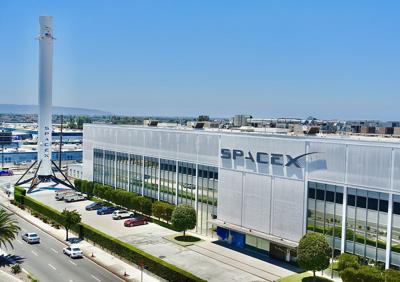



SpaceX facility, Hawthorne, California
SAN FRANCISCO — A federal appeals panel won’t let SpaceX use arbitration to evade a sexual harassment and wrongful termination lawsuit from former employees, writing in a 2-1 ruling that allegations of sexual harassment could be enough to sidestep arbitration clauses in employment contracts.
Eight people sued SpaceX and owner Elon Musk in California state court, claiming they lost their jobs after sending a letter to management alleging various acts of sexual harassment at the workplace. SpaceX removed the complaint to federal court, then moved to compel arbitration, citing a contract clause. But U.S. District Judge John Kronstadt agreed with the workers, who invoked the 2021 Ending Forced Arbitration of Sexual Assault and Sexual Harassment Act.
SpaceX challenged that ruling before the U.S. Ninth Circuit Court of Appeals, which said the question turns on the law’s definition of a “sexual harassment dispute” and what is required of underlying allegations.
Judge Michelle Friedland wrote the panel’s opinion, filed Nov. 10; Judge Danielle Forrest concurred. Judge Eric Tung dissented.
The complaint, according to Friedland, alleges “sexual banter, sexual harassment and gender discrimination were commonplace” at SpaceX and specifically “that Musk normalized and encouraged such conduct,” particularly through social media posts.
Because Musk “intentionally drew employee attention to his Twitter feed by frequently using the account to report out company news,” according to the complaint, but also used the feed for “sexually explicit posts, as well as some that demeaned women and LGBTQ persons,” Friedland wrote, adding the workers alleged SpaceX employees widely shared such posts.
SpaceX fired four of the workers the day after the letter circulated, stating as a reason they were involved in “conceiving, writing and distributing the open letter.” It fired the other four after a human resources investigation let to each one admitting their participation.
“Plaintiffs’ claims fall into five categories,” Friedland wrote. “Hostile-work-environment sexual harassment created by Musk’s Twitter posts; sexual harassment by coworkers; failure to prevent discrimination, harassment and retaliation; gender discrimination; and retaliatory termination for opposing alleged sexual harassment through the Open Letter.”
Some asserted just a subset, but all eight brought the retaliatory termination allegation. Only one plaintiff alleged sexual harassment by a coworker. Rather than move for dismissal, SpaceX filed an answer, then removed the complaint to federal court. There, it moved to compel arbitration, arguing the EFAA didn’t apply because the complaint lacked a claim of sexual harassment “that would survive a motion to dismiss under the federal pleading standard,” Friedland wrote, further claiming Musk’s posts weren’t pervasive or severe enough to affect employment conditions.
“The EFAA’s definition of ‘sexual harassment dispute’ does not say that a plaintiff must ‘adequately allege’ sexual harassment, ‘state a claim to relief that is plausible on its face’ or provide a ‘short and plain statement’ showing entitlement to relief,” Friedland wrote, adding that “when Congress wants to require allegations that meet the federal pleading standard, it has typically said so expressly.”
Friedland framed Judge Tung’s dissent, as did SpaceX’s arguments, relied on a secondary definition of the word “allege” taking it beyond asserting something as true, with truth yet to be determined, to instead mean “to state facts that, if true, would establish that an opposing party’s conduct constitutes a legal violation.”
Although the majority agreed there are “rare instances” where the word is used as shorthand for “adequately allege,” Friedland said Tung “does not explain why the more restrictive meaning applies here.” She also rejected SpaceX’s concerns about the possibility of plaintiffs avoiding arbitration by adding sexual harassment claims to conduct that doesn’t rise to that level, noting “there is an obvious remedy for that problem: the defendant may file a motion to dismiss.”
As such, whereas Tung warned of a “sweeping dispatch of fundamental pleading standards,” Friedland said parties would still have to follow typical procedures, but the “question is whether a court or an arbitrator is the one to rule on that motion to dismiss.” As to concerns about being forced to waive the right to arbitrate other aspects of larger complaints, the majority noted “the EFAA precludes arbitration of an ‘entire case’ that ‘relates to’ the sexual harassment dispute.”
As to whether these specific plaintiffs properly invoked the EFAA, Friedland said they satisfied the conditions. The complaint alleged retaliation based on opposition to conduct they considered sexual harassment and a dispute about whether such conduct meets the legal threshold. It affirmed Judge Kronstadt’s ruling.
In his dissent, Judge Tung insisted the majority’s logic means “an employee can evade arbitration simply by saying that the dispute is about sexual harassment — even if the conduct alleged would not remotely constitute sexual harassment under the law. A bare assertion, says the majority, is enough.”
Tung further called the EFAA “a minefield of redundancy” but read the law to “contemplate judicial inquiry as to whether the facts of the complaint constitute a legal claim before a plaintiff can invoke the EFAA.”
Plaintiffs, he said, must be required to allege specific conduct, not a legal conclusion that harassment existed.
The workers are represented by Lieff Cabraser Heimann & Bernstein and Burgess Law Offices, both of San Francisco.
SpaceX and Musk are represented by Morgan Lewis & Bockius, of Washington, D.C., San Francisco and Los Angeles.
Public Justice, of Washington, D.C., and Oakland, filed a support brief along with the National Women’s Law Center, American Association for Justice and National Employment Lawyers Association.
Equal Rights Advocates, of San Francisco, filed a support brief with the California Employment Lawyers Association, California Women’s Law Center and Legal Aid.
