
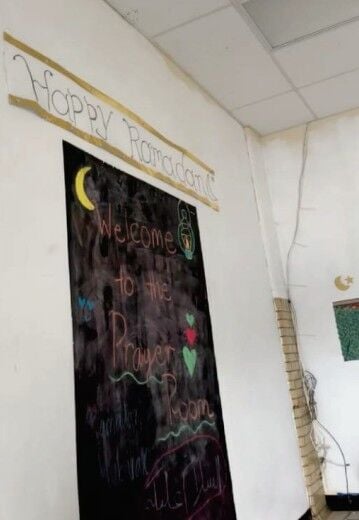
The Prayer Room at The Academy at Palumbo
PHILADELPHIA – Students shamed after an incident in an alleged Islamic “prayer room” in a Philadelphia high school will get to sue school officials, as a federal judge has ruled the room was possibly a violation of the U.S. Constitution.
It was marked with a Palestinian flag on June 11, 2024, catching the curiosity of a Jewish former student at the Academy at Palumbo and two friends who were later the subjects of online vitriol and death threats over what was said to have happened inside it.
Philadelphia judge John Milton Younge recently ruled that the room’s very existence possibly violated the Establishment Clause, while suspended students are also allowed to sue over alleged due process violations. Though the school district argued the room was open to all who wished to pray, it could be interpreted that it was Muslim-only, Younge wrote.
“Here, student plaintiffs plausibly allege that (school staff) suspended them for entering the Muslim Prayer Room as non-Muslims,” Younge wrote.
“They also plausibly allege that they were suspended to pacify Palumbo students’ outrage, thereby reinforcing the student body’s perception that the Prayer Room was available to Muslim students only.”
In the final days of the 2023-24 school year, students were allowed to roam the building. Even former students like M. Danowitz, who is Jewish, entered the campus and freely strolled the halls without objection.
Danowitz, John Hiester and Meru Parmar headed to the library, where they found an open door marked “Quiet Room” and featuring a Palestinian flag. Inside were Islamic religious decorations and Arabic signage, and a sign welcoming people to the “Prayer Room.” Another signed wished a “Happy Ramadan.”
There were also guidelines from a Muslim student association for using the Quiet Room. Danowitz decided to recite a Jewish prayer in Hebrew, which drew laughs from the female students inside who asked why the boys were in the room.
Danowitz declared himself a proud Zionist, cited his First Amendment right to do so and sang a Jewish-pride song. He closed with a handstand and took a placard off the wall and set it on the floor, the lawsuit says.
Danowitz’s actions, recorded by a Palumbo student, didn’t sit well with the community. Hiester received a barrage of messages seeking Danowitz’s location, and a Muslim student who allegedly assaulted Hiester in the past confronted Parmar in the computer lab, accusing him of trashing the Prayer Room.
Dean of Student Conduct Rashida Stamps notified Principal Kiana Thompson of a potential hate crime. Hiester, who had left school out of concern for his safety, was urged to return by his parents. He says he was confronted and threatened in a bathroom. Parmar’s father was told there were “serious accusations” of “harassment of girls.”
Meanwhile, rumors escalated online. The three were accused of desecration and harassment, and their names and social media handles were specifically mentioned in posts. Their parents pleaded that their children weren’t safe at school, and Thompson was directed to suspend Parmar and Hiester by Richard Gordon IV, the assistant superintendent of the School District of Philadelphia.
Thompson would not meet with parents the following day, calling the police to remove them. She’d also filed a police report, the lawsuit says, and parents headed to SDP’s main office to show video that contradicted the accusations their boys were facing. One teacher at another school alleged they had imitated sex acts while grinding on the floor and posted those comments she made at a school board meeting on X.
One initial report labeled the boys as “five Jewish male students,” though Parmar and Hiester are not Jewish. They claim their punishment came because they, as non-Muslims, entered a room the school had essentially reserved for Muslims.
Parmar and Hiester left the school district and sued over the suspension and the Prayer Room. Though some claims were dismissed in Younge’s ruling, others will continue.
“Defendant Thompson suspended Student Plaintiffs on a Wednesday night,” Younge wrote. “She could have consented to meet with Plaintiffs to provide notice and hearing when they came to Palumbo seeking to meet with her the next morning.
“Or, in a post-COVID world where remote learning is commonplace, Thompson could easily have arranged a video conference with the Student Plaintiffs.”