
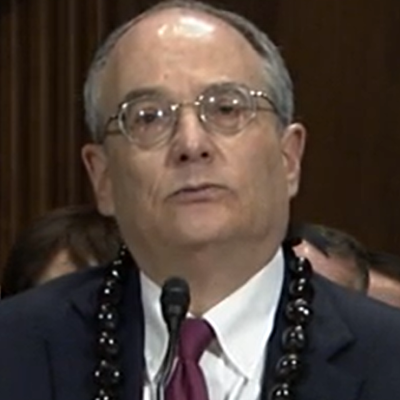


U.S. Ninth Circuit Court of Appeals Judge Mark J. Bennett
SAN FRANCISCO — California election officials don't need to set aside tens of thousands of ballots from non-citizens to whom California election authorities may have issued mail-in ballots, a divided federal appeals panel has ruled.
On Oct. 26, in a 2-1 decision, a three-judge panel of the U.S. Ninth Circuit Court of Appeals rejected the request from the Justice Department under President Donald Trump for an emergency order directing state and county officials to sequester the potentially illegal ballots, preventing them from being counted following the November elections.
The majority opinion was unsigned and issued per curiam. It was joined by Ninth Circuit judges Mark Bennett and Gabriel Sanchez.
Bennett was appointed to the court by President Trump during his first term. Sanchez is an appointee of former President Joe Biden.
Ninth Circuit Judge Patrick Bumatay dissented. Bumatay was also appointed to the court during Trump's first term.
In the decision, the majority said they believed the federal government had essentially jumped the line, asking an appeals panel to step in when it perceived a federal district court judge was taking too long in addressing what the government argued was an emergency situation.
The majority, however, said the emergency was instead "at least in part, a self-constructed one."
"At least part of the delay here is attributable to the United States’s own delay in filing suit, in realizing that existing California state law governs the issuance and processing of ballots, in recognizing that California has millions of registered voters and processes ballots on a schedule aligned with that scale, and in communicating to the court its desired relief," the majority wrote.
So, they said, the court lacked jurisdiction to hear the appeal, at least until the lower court judge first rules on the administration's attempt to wall off the allegedly illegal ballots.
In dissent, however, Bumatay said he believed the facts of the case should have required the courts to step in and force the state of California to follow federal law. Instead, Bumatay said, his colleagues decision all but now allows California to continue to defy the law and willingly count ballots identified by the federal government as illegal.
"The federal government came to us for help as it sought to enforce Congress’s law against illegal voting by aliens. It did so because California would not help," Bumatay wrote.
"Instead, California interpreted state and federal law to stop it from doing so, while empowering it to mix legal and likely illegal ballots together. Because the State frustrates federal law by relying on that interpretation to commingle ballots, its actions are preempted. We should’ve stopped it from doing so and effectuated Congress’s will."
The matter landed before the Ninth Circuit late last week and a little over a week after the Trump administration sued California over the allegedly illegal ballots.
The dispute, however, dates back months further, when the federal government first warned California that at least thousands of people registered to vote in California were not actually citizens, and thus were not eligible to vote in elections for federal offices, under federal law.
California officials, however, refused to cooperate with the federal government in "confirming the citizenship status of those individuals on the list."
Instead, on Oct. 1, California mailed out ballots to every registered voter on its list, as required by state law.
The administration then sent California a list of more than 20,000 specific individuals it believed could illegally use those mail ballots to vote this fall. The federal government then requested California set those ballots aside and not count them until the suspect voters' citizenship could be confirmed.
California refused again to cooperate, prompting the Trump administration to sue and request a temporary restraining order, forcing the state to cooperate and comply with the federal government's request.
While the administration asserted the matter was urgent, U.S. District Judge David O. Carter –an appointee of former President Bill Clinton – didn't set a hearing on the TRO motion until Oct. 27.
The Justice Department then appealed to the Ninth Circuit, seeking emergency action. They noted, for instance, that Los Angeles County alone had already processed more than 300,000 mail-in ballots, and more were arriving each day, sometimes by the thousands.
California opposed that motion, arguing there was not actually an emergency and the appeals court lacked jurisdiction at this point to hear the challenge.
California further asserted it would face “a logistical and administrative nightmare” were it to be required to locate and separate the potentially illegal votes at this point in the process.
The majority agreed that the appeals court lacked jurisdiction.
However, Judge Bennett, in a special concurrence, went further still, saying he would also rule that the executive branch of the federal government lacks any legal authority whatsoever to interfere in a state's ability to determine who is and is not an eligible voter.
Bennett said under federal law, the only branches of U.S. government authorized to set election rules or voter eligibility standards and requirements are Congress and the individual states.
"California details the exact manner in which a citizenship challenge to a voter needs to be brought, not only in the days leading up to the election, but all the way through election day and the counting of the votes. Plaintiff’s request to challenge vote-by-mail ballots, by asking Defendants to segregate ballots alleged to be cast by noncitizens, contravenes the State’s procedures for handling such a challenge," Bennett wrote.
Under California law, challenging the citizenship of voters is a difficult and drawn out process.
Election officials are required to issue ballots to anyone who signs an attestation swearing they are a citizen, ostensibly under penalty of law.
Then, only election officials and election observers are empowered to challenge that claim to citizenship, if they have at hand strong documented proof that the potentially illegal voter has lied to gain access to a ballot.
Under California law, any doubt automatically goes to the benefit of the accused illegal voter.
But Bennett said, under the law, California is allowed to set up its own standards and processes, and those are not preempted by current federal law.
"If Plaintiff believes requiring additional confirmation of citizenship is necessary for vote-by-mail ballots, I believe the appropriate audience for that suggestion, in full accord with the plain language of the Elections Clause, is Congress, not the courts," Bennett wrote.
