
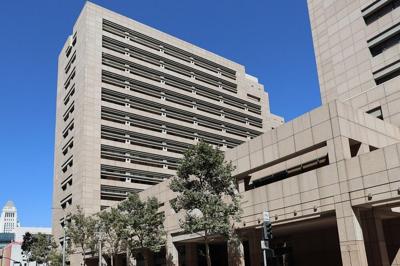



Ronald Reagan State Building, home of the California Second District Court of Appeal, Los Angeles
LOS ANGELES — A state appeals panel has upheld a $51 million verdict awarded to a man who said his wife died of mesothelioma resulting from exposure to asbestos in Avon cosmetic products containing talc.
Gary Chapman said his late wife, Rita-Ann, was 8 years old when she started using Avon’s talcum powder in 1954, a habit she kept up multiple times each week through 1978, then again from 1995 through 2010. According to court documents, doctors diagnosed her with mesothelioma before 2021, which is when the Chapmans sued several dozen defendants, including Avon and companies in the automotive brake industries, as Gary worked in that field.
According to court records, at the outset of the trial only Avon and Hyster-Yale Group remained as defendants. Rita-Ann died in March 2025.
Los Angeles County Superior Court Judge Lawrence Riff presided over a lengthy trial at which a jury found Avon strictly liable for its products lacking adequate warnings as well as liable for negligence and fraudulent misrepresentation and concealment. It awarded compensatory damages of $40.8 million and punitive damages of $10.3 million, finding Avon 90% at fault.
Avon challenged the verdict before the California Second District Appellate Court. It argued against the testimony of an expert opinion regarding the presence of one form of asbestos in its talc products; said one of its own witnesses was improperly excluded on disclosure grounds; claimed a medical doctor shouldn’t have been allowed to offer opinions on asbestos testing methods and Avon’s internal documents; and finally contended there isn’t reliable evidence of the products containing asbestos or that those products caused Chapman’s disease.
Justice Maria Stratton wrote the panel’s opinion, filed Feb. 11 and certified for publication March 4; Justices John Wiley and Victor Viramontes concurred.
“The Chapmans took a multi-pronged approach to proving the presence of asbestos in Avon talc products,” Stratton wrote. “They relied on Avon’s own documents to show the presence of asbestos in its talc products in the early 1970s. They relied on studies showing the presence of asbestos in the mines which were Avon’s source of talc for its products. They retained an expert to test new samples from some of those source mines. They acquired vintage containers of Avon talc products, from a variety of sources, which their expert tested.”
Avon’s challenge to Dr. William Longo, who testified about the presence of chrysotile asbestos in talc in Avon products, involved concerns about whether his modern technique had general acceptance in the scientific community. The panel found Judge Riff considered “the alleged novelty of Longo’s technique,” but also said Avon waived its right to challenge by agreeing, in response to questioning from Riff, that “novelty in and of itself is not determinative.”
Longo's testimony and claims concerning the presence of asbestos in talc have served as the basis of tens of thousands of lawsuits against the makers of talc products, including Avon and Johnson & Johnson.
Recently, J&J has asked a judge overseeing multidistrict litigation against the company to disqualify Longo, among other key witnesses, saying Longo's work is essentially a large component of an "echo chamber" of alleged junk science used to buttress legal claims collectively worth billions of dollars to trial lawyers.
J&J has particularly noted Longo once dismissed the idea of asbestos in talc as an “urban legend,” but then switched after lawyers hired him in talc cases. They say he has also switched research methods, to those favored by trial lawyers to achieve the results they desire.
In the Chapman case, however, the appeals judges allowed Longo's testimony to stand, with Stratton saying: “Although Avon’s experts challenged Dr. Longo’s testimony, detection of asbestos has been evolving for 50 years and Avon was unable to show that Longo’s testimony and methods were illogical, clearly unreliable, or based on invalid scientific theories.”
Avon also argued Judge Riff wrongly refused to allow it to call Lisa Gallo, Avon’s former vice president of Global Innovation, Research, and Development, as a witness, claiming he did so because it listed her as a corporate witness and not specifically a fact witness.
But the panel said it felt Riff excluded her because the Chapmans argued her testimony “as a person most qualified to speak for Avon would be inadmissible hearsay if offered by Avon” and also that Avon didn’t identify her in pretrial proceedings as having personal knowledge of its claims or defenses and that “the Chapmans had objected based on Ms. Gallo’s lack of personal knowledge, a fact she had admitted in her deposition testimony.”
The panel took Avon to task for its opposition to a Chapman witness regarding asbestos testing and corporate documents, with Stratton writing “Avon has simply listed very brief summaries of testimony it claims is improper in the form of a list of bullet points. There is no detailed analysis of the actual testimony, and no cogent argument as to why each piece of testimony is improper. This failure waives the claim.”
Finally, the panel said Avon waived its claim the Chapmans’ evidence was insufficient. Stratton explained a party making such a challenge must, at minimum, summarize the evidence, both for and against its position, and show how the evidence is insufficient to reach a conclusion.
“Avon has not come close to meeting even the minimal requirement of setting forth all the material evidence that is unfavorable to its position, let alone setting forth the version most favorable to plaintiffs,” Stratton wrote. “The Chapmans’ appellate brief clearly shows the extent of the evidence Avon failed to cite and discuss, as does the Statement of Facts in this opinion. We do not consider Avon’s attempt to address this evidence in its reply brief, because there was no reason for Avon to have failed to address the evidence in its opening brief. It is Avon’s burden to show error, and particularly in the context of an insufficiency of the evidence claim, appellant cannot shift that burden onto the Chapmans, or onto this court. Accordingly, Avon has waived this claim.
The panel affirmed the verdict and ordered Avon to pay the Chapmans’ costs of defending the appeal.
Avon is represented by attorneys Amari L. Hammonds, Lisset Pino, Geoffrey Shaw, Robert M. Loeb, Upnit K. Bhatti, of the firm of Orrick, Herrington & Sutcliffe, of Los Angeles; and Margaret I. Johnson, of Foley Mansfield, of Los Angeles.
Chapman is represented by attorneys Lisa W. Shirley, Jessica M. Dean and Benjamin H. Adams, of the firm of Dean Omar Brenham Shirley, of Dallas.
The Coalition for Litigation Justice and Civil Justice Association of California filed support briefs for Avon.