

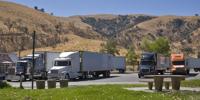


A group of semis at a truck stop in rural California.
LOS ANGELES - A federal judge has refused to issue an order forcing California to defy the federal government and resume issuing CDLs to immigrant truck drivers, including those who may be in the country illegally or who are not legally authorized to work in the U.S.
On Jan. 20, U.S. District Judge Jesus G. Bernal, of the U.S. District Court for the Central District of California, denied a request for a temporary restraining order sought by a group representing Chinese immigrant truck drivers.
The lawsuit, filed on Jan. 7 in Los Angeles federal court by the Chinese American Truckers Association, follows a similar suit filed just before Christmas in Alameda County Superior Court by a group representing Punjabi Sikh immigrant truck drivers.
That case remains pending.
But both cases center on similar claims: That the state of California was wrong to bow to the demands of the Trump administration and to pause the issuance of commercial drivers licenses to immigrant truck drivers, including illegal immigrants.
The U.S. Department of Transportation under Transportation Secretary Sean Duffy has sought to slam the brakes on the issuance of CDLs to immigrants throughout the country amid a series of high-profile fatal crashes and other traffic incidents involving immigrant truck drivers, including some who government investigators determined cannot read or speak English proficiently enough to understand road signs or basic commands essential to safely operating large commercial vehicles on U.S. roadways.
Duffy's USDOT has particularly zeroed in on the issuance of so-called "non-domiciled CDLs" to non-citizen immigrant truckers.
State departments of motor vehicles are typically empowered by law to evaluate and issue CDLs, the class of drivers licenses which allow drivers to operate semi trucks and other large commercial vehicles.
However, CDL issuing standards and rules are largely set by the USDOT, as commercial trucking implicates interstate commerce, a realm reserved under the U.S. Constitution to the federal government to regulate.
U.S. citizens generally have a right to obtain a CDL, if they pass licensing tests and abide by other rules.
However, states are also authorized to issue CDLs to some immigrants who are not permanent residents of the U.S. under so-called "non-domiciled" classifications. Such non-domiciled CDLs can be issued to applicants who can pass U.S. CDL licensing exams, yet are citizens or legal permanent residents of countries other than the U.S., Canada or Mexico.
According to guidelines, such non-domiciled CDL holders must prove that they are in the U.S. legally, presenting immigration papers, including so-called work authorization documents.
However, the USDOT has reported in recent months that its ongoing audits of non-domiciled CDLs issued by states have revealed that a growing number of states have been issuing such non-domiciled CDLs to illegal recipients.
Duffy and the Trump administration has particularly called out California as among the most "egregious" of all state governments in issuing allegedly illegal CDLs to immigrants.
In response to regulatory pressure from USDOT and its subsidiary trucking regulatory body, the Federal Motor Carrier Safety Administration, California reportedly paused issuing non-domiciled CDLs beginning in September 2025.
And the California Department of Motor Vehicles issued notices to at least 20,000 immigrant truckers, saying the state intended to move in early January 2026 to cancel their CDLs because in many cases the expiration date of their CDLs extended beyond the date their legal authorization to work in the U.S. would end.
The immigrant truckers groups said this amounted to an illegal "open-ended suspension" for immigrant drivers and the businesses that employ them.
Both cases assert the California DMV must take action to address "clerical errors" that allegedly caused the state to issue the alleged illegal non-domiciled CDLs with expiration dates that extend beyond the time the drivers are legally authorized to work in the U.S.
Following the filing of the Sikh drivers' complaint, the California DMV announced it would put off the decision on cancelling non-domiciled CDLs for at least two months.
That decision came under immediate fire from Duffy, who asserted in statements on social media that California lacks the legal authority and flexibility to forestall the CDL cancellations. Should the state continue to “extend” the process, Duffy threatened to cut off at least $160 million in federal transportation funds to the Golden State.
In his ruling, Bernal referenced such federal actions to cut off transportation funding from California, should the state continue to take steps that are interpreted by Washington as pro-immigrant defiance.
In the ruling, Bernal noted the Chinese American Truckers Association asserted that granting the order they seek would carry limited real world consequences, because "the harms California risks constitute 'a speculative fear of federal consequences.'"
Bernal, however, said such an assertion "blinks reality."
He noted the state has already lost $150 million in federal highway funding, because the U.S. DOT determined "the state is noncompliant with federal standards." From there, the DOT could withhold even more funding, or even decertify California's CDL program entirely, which would block the state from issuing or renewing CDLs entirely.
"Plaintiff lists nine members who are affected by the non-domiciled CDL issuance pause," Bernal wrote.
"While the Court is sympathetic to those individuals who are allegedly impacted by the pause, it cannot be that the interests of those nine individuals (and even many other non-domiciled CDL holders seeking replacement or renewal) outweighs the state’s and public’s interest in continued issuance capacity for all CDLs in the state, along with more than $300 million in highway funding," Bernal wrote.
Further, the judge noted, even if the court granted the plaintiffs everything they seek and California sought to comply with the court order, the odds are high that the likely response from the federal government would result in them still being unable to obtain the commercial drivers licenses they say they are owed.