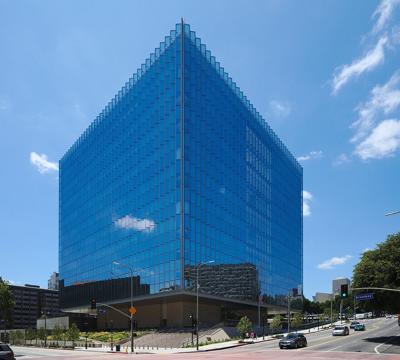


Felicitas and Gonzalo Mendez United States Courthouse, Los Angeles
LOS ANGELES — Federal courts in and around Los Angeles are driving a recent surge in consumer protection litigation nationally, with the cases in the Central District of California accounting for 9.3% of the U.S. total, making it the busiest federal venue for consumer filings.
That’s among the conclusions of Lex Machina’s Consumer Protection Litigation Report 2026, which was released this week by the legal analytics platform. The Central District of California handled 4,682 consumer protection cases in the 2023-2025 time period, according to the report, well above the second most active federal court, the Middle District of Florida, which recorded 3,097 such filings.
Nationwide, claims related to artificial-intelligence technologies along with filings dealing with credit reporting, unwanted telephone solicitations and data breaches shot up to a 10-year high in 2025, according to the study.
Other federal district courts in California felt the surge in consumer-driven litigation. The Northern District ranked the sixth busiest in the country with 1,960 such cases over the 2023-2025 time period, recording a spike of 51% last year alone, the report said. The federal court based in San Diego recorded 1,163 consumer filings over the same period, many of which involved alleged violations of the Telephone Consumer Protection Act (TCPA).
The Lex Machina report also found that a long-term reduction in consumer-protection appeals has been reversed in recent years. Specifically, the San Francisco-based Ninth Circuit recorded 704 appeals of consumer cases from 2023 through last year, a total representing 31.5% of all consumer appeals in the country, the study said.
“California remains the primary battleground for everything from tech-driven AI privacy suits to changing state warranty laws,” a Lex Machina spokesperson said.
In addition to rising TCPA filings nationwide, the report said that Fair Credit Reporting Act (FCRA) cases rose 44% in 2025, reaching a total of 7,750 compared to 5,364 in the previous year. Overall, the number of consumer protection damages awards actually declined between 2024 and 2025, going from 452 to 437. But the value of those awards rose 35% to more than $7.5 billion during that time, excluding fees and interest, the report found.
Despite the surge in consumer litigation in California federal courts, the report found that warranty claims filed under the state’s Song-Beverly Consumer Warranty Act seemed to have peaked last year as a result of the passage of legislation limiting filing periods and fee recoveries.
The report also found that the use of AI by employee recruitment companies to gather data to rank job applicants has come under the scrutiny of trial attorneys, who see such activities as ripe for FCRA violations.
“Kistler et al v. Eightfold AI. Inc. (in the Northern District of California) illustrates this emerging theory of liability,” the report states. “Filed in California state court in January 2026 and removed to federal court, the plaintiffs allege that automated applicant profiles were consumer reports supplied without required disclosures or opportunities to dispute errors.”
Laura Hopkins, Lex Machina’s legal data expert, told the Southern California Record in an email that the legal theory centers around the FCRA’s definition of a “consumer report.”
“The FCRA broadly defines a consumer report to include information provided by a consumer reporting agency concerning an individual's character, general reputation, personal characteristics or mode of living that is used to evaluate eligibility for employment,” Hopkins said. “As AI becomes more widely used to screen and rank applicants, courts may be called upon to determine whether these assessments fall within that definition, potentially opening the door to increased litigation.”
Meanwhile, the number of consumer protection lawsuits filed by federal agencies has nose-dived, according to the study. Such lawsuits filed by the Consumer Financial Protection Bureau plunged by 80% in 2025 while the Federal Trade Commission’s consumer filings dropped 47%.