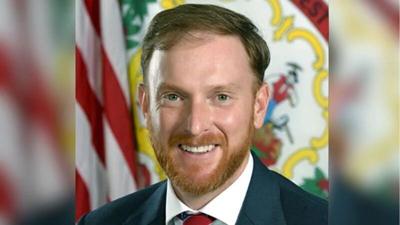


West Virginia Attorney General J.B. McCuskey
HUNTINGTON – Apple wants West Virginia’s lawsuit alleging its knowingly allows its iCloud platform to be used as a vehicle for distributing and storing child sexual abuse material removed to federal court.
The complaint, which West Virginia Attorney General J.B. McCuskey calls a first-of-its-kind lawsuit, claims Apple knew about the problem for years but chose to do nothing about it.
McCuskey’s office filed the lawsuit in February in Mason Circuit Court. Apple filed its notice of removal in federal court April 1.
“Preserving the privacy of child predators is absolutely inexcusable,” McCuskey said during a February 19 press conference announcing the lawsuit, which was filed in Mason Circuit Court. “And more importantly, it violates West Virginia law.
“Since Apple has so far refused to police themselves and do the morally right thing, I am filing this lawsuit to demand Apple follow the law, report these images, and stop re-victimizing children by allowing these images to be stored and shared.”
The AG’s office says the consumer protection complaint is the first lawsuit of its kind brought by a governmental agency against Apple over child sexual abuse material (CSAM) distribution
The lawsuit claims Apple, in its own internal communications, described itself as the “greatest platform for distributing child porn” — yet took no meaningful action to stop it.
Instead of using industry-standard detection tools used by its peers, Apple allegedly repeatedly shirked its responsibility to protect children under the guise of user privacy.
McCuskey’s office says federal law requires all technology companies based in the United States to report detected CSAM to the National Center for Missing and Exploited Children.
In 2023, Apple made just 267 such reports. By contrast, Google filed 1.47 million reports, and Meta filed more than 30.6 million.
McCuskey says Apple’s failure to use available detection technology is not a passive oversight — it is a choice.
Because Apple maintains end-to-end control over its hardware, software, and cloud infrastructure, the lawsuit claims the company can’t claim to be an unknowing, passive conduit of CSAM. The complaint says Apple designed, built and profited from the system it allowed to be weaponized against children.
In a statement, Apple said emphasized its controls that prevent children from uploading or receiving nude images, though West Virginia’s lawsuit aims at abusers’ use of Apple devices and services.
“At Apple, protecting the safety and privacy of our users, especially children, is central to what we do,” the company said. “We are innovating every day to combat ever-evolving threats and maintain the safest, most trusted platform for kids.”
In the complaint, the AG’s office seeks statutory and punitive damages, injunctive relief requiring Apple to implement effective CSAM detection measures, and equitable remedies mandating safer product design going forward.
In its federal court filing, Apple says it is required to report any known apparent violations of the federal CSAM laws to the National Center for Missing and Exploited Children through its CyberTipline. It says the state’s complaint is based on alleged flaws in Apples CSAM monitoring and detection practices.
“Each of the state’s claims is premised on the theory that Apple has violated West Virginia law by failing to search for and identify any CSAM content of its users – and that West Virginia law thus affirmatively requires providers like Apple to monitor and affirmatively search and screen the content of its users,” the removal notice states. “These claims – and any injunctive remedy requiring Apple to conduct searches of its users’ content – conflict with and are preempted by (federal code) and the Fourth Amendment.”
In addition to McCuskey and Assistant AGs Jace Goins and Abby Cunningham, private attorneys Troy Giatras and Matthew Stonestreet are representing the state. Apple is being represented by Steven Ruby and David Pogue of Carey Douglas Kessler & Ruby in Charleston
U.S. District Court for the Southern District of West Virginia case number 3:26-cv-240 (Mason Circuit Court case number 26-C-16)