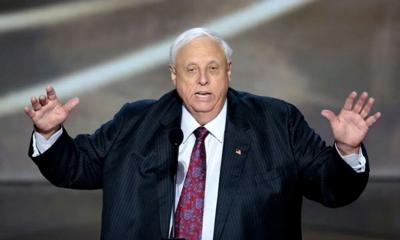


Sen. Jim Justice (R-W.Va.)
WASHINGTON – The Senate Ethics Committee has publicly admonished Sen. Jim Justice, finding the West Virginia Republican violated federal law and Senate rules by failing to file his annual financial disclosure on time despite two extensions and repeated reminders.
In a November 10 letter, committee Chairman James Lankford (R-Oklahoma) and Vice Chairman Chris Coons (D-Delaware) said Justice’s failure undermined public confidence in the Senate. Justice ultimately submitted the report September 8, nearly a month after his extended deadline.
“The public must feel confident that Members never place personal financial interests ahead of the best interests of the United States,” the senators wrote. “Your actions failed to uphold that standard, resulting in harm to the public trust and confidence in the United States Senate and a violation of federal law.”
Justice acknowledged the lapse in a statement, saying his longtime accountant had been dealing with his wife’s terminal illness.
“Admittedly, we did not fully appreciate the significance of filing the financial disclosure late,” Justice told MetroNews. “Nevertheless, it should have been filed on time, period. It won’t happen again.”
Federal law requires senators to file annual reports detailing their assets, liabilities and sources of income by May 15. Justice received two extensions that moved his deadline to August 13, according to the committee’s letter.
The panel said Justice’s filing assistant acknowledged six communications during the six months before the deadline reminding him of the requirement and offering help. But the assistant did not tell the committee Justice would miss the deadline until less than 30 minutes before it expired.
The committee said it had no record of another senator failing to file a timely annual financial disclosure report since enactment of the Ethics in Government Act of 1978.
The senators acknowledged the family hardship involving Justice’s accountant and filing assistant but said it did not excuse his failure to comply.
The circumstances, “for which the Committee has great compassion,” did not “abrogate your personal responsibility as a U.S. Senator to comply with governing federal law,” they wrote.
The public admonition does not constitute a formal punishment under Senate practices.
Justice’s financial troubles extend beyond his late Senate disclosure, with his family’s resort and coal businesses embroiled in disputes over unpaid debts, taxes and contractual obligations.
The Greenbrier, the historic West Virginia resort his family bought out of bankruptcy in 2009, faced a court fight this year after an Omni Hotels affiliate acquired about $300 million in debt secured by the property and sought to place it under a court-appointed receiver. The Justice family disputed the creditor’s actions, alleging the debt sale was an improper effort to seize control of the resort.
Those lawsuits were dismissed in August after the family completed a $500 million financing and joint venture agreement with Kennedy Lewis Investment Management. The deal relieved the immediate threat of a court-ordered takeover but gave the investment firm a 51% controlling interest in The Greenbrier and a majority on its governing board. The family said the financing would allow it to pay creditors, including state and federal tax authorities, and fund improvements to the resort.
Justice also faces substantial personal liability tied to his family’s coal operations.
In October, the 6th U.S. Circuit Court of Appeals upheld a $25.2 million judgment, plus interest, against him in favor of Lexon Insurance Co. The dispute involved unpaid collateral and overdue premiums on surety bonds backing the companies’ mining obligations. Justice had personally guaranteed repayment; the appeals court rejected his arguments that his liability was more limited.
A separate, decade-long dispute over unpaid mining royalties and retainer fees produced a roughly $18 million ruling in July involving the family-owned Kentucky Fuel business. The case stemmed from a 2012 lawsuit brought by New London Tobacco Market and Fivemile Energy and involved Justice’s son, Jay Justice, and a company associate – a separate legal matter from the senator’s personal obligation in the Lexon case.