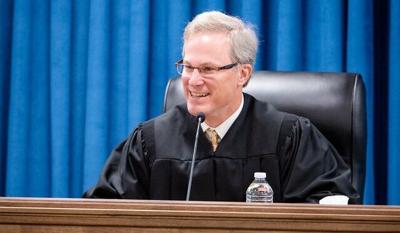



West Virginia Intermediate Court of Appeals Judge Dan Greear
CHARLESTON – Dan Greear is back for a second term as chief judge of the West Virginia Intermediate Court of Appeals.
Greear, 57, was the court’s first chief judge when the court opened July 1, 2022. His first term was 18 months. Former ICA Judge Thomas Scarr served as chief in 2024, and Judge Charles Lorensen served in 2025. Judge Ryan White, who replaced Scarr on the court last year, will serve as chief in 2027.
“The ICA has been well served by Chief Judge Lorensen,” Greear said. “I look forward to working with Judges Lorensen and White to ensure that the ICA continues to function to meet the needs of West Virginia and to continue to improve our judicial system.”
Despite criticism that the ICA wasn’t needed when it was created by the West Virginia Appellate Reorganization Act of 2021, Greear said the numbers show a positive impact on the state court system.
“In its recent budget presentation to the Legislature, the state Supreme Court talked about the effect we’ve had on their docket,” Greear told The West Virginia Record. “We have four main areas of jurisdiction. Those are civil, workers’ compensation, family court guardianship and conservatorship cases and administrative.
“In all four of those, the Supreme Court is down significantly. There’s a 47% reduction in the number of civil cases the Supreme Court, a 50% reduction in family court matters, a 76% reduction in administrative law and about 70% reduction in workers’ comp.”
Greear says those figures show just how significant the ICA is.
“That’s even more than I thought that we are doing in terms of taking the load off the Supreme Court,” he said.
He also noted some preliminary figures from addition research being done about the ICA’s impact on the Supreme Court.
“The average time it's taking the Supreme Court to get to a case actually has decreased since 2022,” Greear said. “I think it’s because of their reduced caseload, which has happened because of the ICA.
“So at least anecdotally and because of stats like these, I think some of the benefit that people wanted to get out of the ICA is coming to pass. But also, I don't think anyone would have expected that the Supreme Court window would have been shorter, too.
“I think you can make a pretty compelling argument that there really has been some benefit to the whole system for the ICA.”
Greear said moving back into the chief judge seat has been an easy transition.
“Judge Lorensen and Judge Scarr did a fabulous job,” Greear said. “And with both of those guys and Judge White, our working relationship has been tremendous. We have a cooperative arrangement.
“Basically, the chief judge runs the oral arguments, we handle procedural questions that come from the clerk.”
Greear said the camaraderie on the ICA is a huge benefit.
“Even when we disagree on cases, we’ve always done it very professionally and cordially,” he said. “We can we can disagree without causing any harm to our relationship or any animosity that need to be there.”
Greear said the second time around is a little different from his first term as chief when the court was finding its footing in its first days of existence.
“We’re not inventing the wheel right now,” Greear said. “The first time, we were dealing with the newness of everything. We’ve now got our systems in place, and we know how we want to do things. We’ve kind of tweaked things to hopefully improve it. So now it’s more of just keeping the ball rolling and making sure we’re getting the decisions out quickly as opposed to figuring out how to do it.
“We plan to continue to just stay on top of things and make sure we’re turning over cases like we should.”
He said those processes has led to quick turnaround for cases.
One of the … I don't know if criticisms is the right word … but one of the talking points for people opposed to the court was that it was going to add expense and delay,” Greear said. “Yes, it is an additional layer in civil cases. But for the other types of cases we hear, we’ve just replaced a layer.
“But in civil cases, when the cases go through us and the Supreme Court, there is additional time expected. It’s about five months extra. How much expense, I don't know. But only about 20% of our cases get appealed to the Supreme Court, and only about 30% of our cases are civil. So, if you multiply that together, that means that in about 6 or 7% of our cases, we are going to have a longer time and more expense.
“Arguably, the other 94% of the cases are either the same or, I think, we’re moving faster now because of these other stats. So., there is a small segment of cases where we’re take longer and maybe cost more. But I think with more cases, we’re arguably quicker and more efficient.”
Greear said he thinks the ICA has been especially important in dealing with family law matters.
“I don’t think you can overstate the difference this is made in family law,” he said. “I mean, quite frankly, the old system was terrible. You were appealing the family law cases of the circuit judges. And this is not a knock on the circuit judges. It’s just that all the circuits were making different rulings on the same issue of law.
So you had family law cases in Kanawha County that could have seven different circuit judges ruling several different ways in Canal County. And then, Kanawha County might handle a case entirely different than Monongalia County has on the exact same issue.
“But now, all those are coming to us. We’re putting out more family law decisions in the Supreme Court ever did, just because they never got them. We’re doing about 80 or 90 family law cases a year where the lawyers and even more importantly, the family judges have those decisions. They can rely on them, and we're settling issues of law. But before, there were all kinds of different answers, depending on which circuit judge heard it.”
Another difference this time around for Greear as chief judge is that he’s also running for re-election to the ICA. So far, his only opponent for the May 12 non-partisan election is Kanawha County Family Court Judge Jim Douglas.
“It’s challenging,” Greear said of juggling court duties with a campaign. “You’ve got to use efficient time management. But we’re going to do the job here, and we’re going to make sure that everything that needs to go into the job goes into the job. I think that's the best campaigning I can do … doing this job right. And that’s my priority.
“If that means I need to read cases at 10 o'clock at night, that’s what I’ll do. I might be doing some work at some non-conventional hours, but I’ll still get the work done.”