
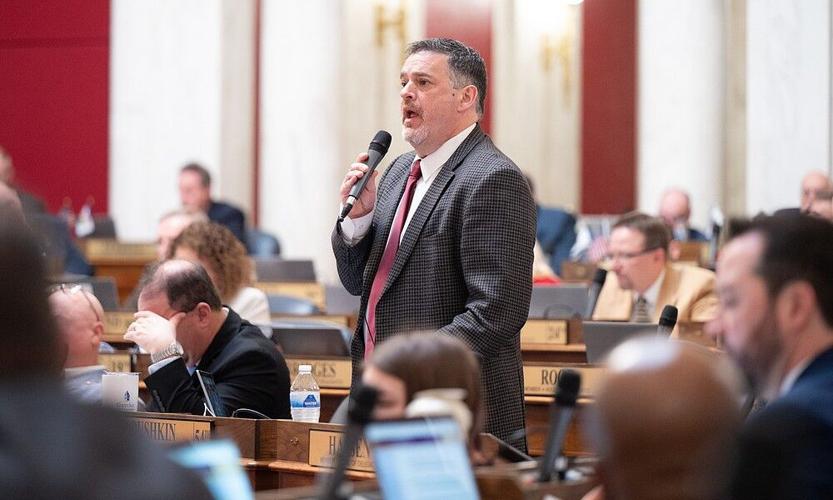



Delegate Mike Pushkin (D-Kanawha) discusses Senate Joint Resolution 9 during the House floor session March 13.
CHARLESTON – The resolution to ensure only United States citizens can vote in West Virginia elections now will be put before state voters.
The House of Delegates approved Senate Joint Resolution by a 97-0 vote March 13. Because the House Judiciary Committee slightly amended the resolution earlier this week, SJR 9 had to be returned to the state Senate to approve the amended version. The Senate passed their version SJR 9 by a 33-0 vote March 3.
On March 14, the final day of the session, the Senate approved the amended version with a 34-0 vote. Resolutions proposing amendments to the state Constitution are adopted by two-thirds of the members of both houses and go directly to the voters, bypassing the governor's signature.
That means the issue will be on the this fall’s general election ballot. It should appear as Amendent 1 and will be called the Citizenship Requirement to Vote in West Virginia Elections Amendment.
"This amendment provides that in all elections held in West Virginia only citizens of the United States who are citizens of this state are qualified to vote,” the ballot will read.
The state director of a group pushing for the passage of the resolution said two unanimous votes in the Legislature sends a strong signal to West Virginia voters.
“There is broad agreement that only U.S. citizens should vote in West Virginia elections,” said Charlie Kolean, state director of Americans for Citizen Voting. “This is a straightforward, commonsense issue. The people of West Virginia now have the opportunity to enshrine citizens-only voting in their Constitution. …

Kolean
“Only American citizens should vote in West Virginia’s elections. Nearly 80 percent of Americans agree that voting should be limited to U.S. citizens. This is commonsense, it’s popular and it’s strengthens trust in our elections and our Republic.”
One state Senator who co-sponsored the resolution agreed.
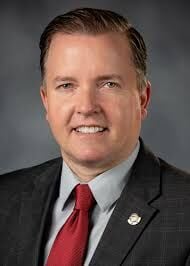
Maynard
“Requiring voters to be U.S. citizens ensures that the people making decisions about our government are those who are permanent members of our nation and communities,” Mark Maynard (R-Wayne) told The West Virginia Record after Saturday’s passage. “Individuals who are in the country temporarily — such as those on work visas or green cards — or those who are not legally present may not remain here long-term to experience the benefits or consequences of the policies enacted.
“Voting is a fundamental part of self-government, and it is appropriate that those decisions be made by citizens who have a lasting stake in the future of the country.”
Friday afternoon’s unanimous House vote came after a few minutes of discussion among delegates.
Delegate Mike Pushkin (D-Kanawha) seemed to question the priorities of Republican lawmakers and legislative leaders.
“This is what we’re voting on … whether or not to put this on the general election ballot in the upcoming election in November. … to change the Constitution to say that only U.S. citizens who are also a citizen of this state may vote in West Virginia,” said Pushkin, who also is chairman of the state Democratic Party. “Can you legally be a citizen of the state but not a citizen of the United States? …
“Say we put this on the ballot, and the voters, as I’m sure they will, the voters go out, and then they vote in favor of it. Does it actually change current law?”
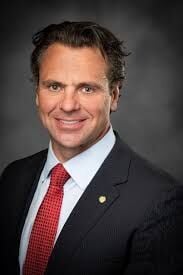
Akers
Delegate J.B. Akers (R-Kanawha) answered.
“I think it just provides more security and clarification under the elections provision,” said Akers, chairman of the House Judiciary Committee. “That’s what the intent appears to be from the Senate when they sent this over to us.”
“So, there’s, like, a belt and suspenders type thing where it's going to make sure twice that only citizens can vote,” Pushkin said.
“You could call it that,” Akers replied.
“So, this doesn't actually change anything at all,” Pushkin continued. “And this is what we’re taking up first today on this second to last day of the session is a resolution that changes absolutely nothing with our elections.
“Think about some of the things we could be discussing, whether it’s the economic development plan that we had with the first bill that was introduced (House Bill 4001, Team West Virginia). Senate wasn’t able to send us that to help us bring businesses to this state, bring investment to our state.
“Instead, we’re discussing a resolution that doesn't actually change anything, or, you know, provide funding for public education. We haven’t been able to update our school aid funding formula in a manner that gives it the attention it deserves. Instead, we’re going to discuss a joint resolution to have a constitutional amendment that changes absolutely nothing.”
Pushkin tried to find a silver lining.
“I guess one thing, one positive that could come from this, it could possibly drive voters to the polls if we have an issue like this on the ballot,” he said. “Of course, I hope that, you know, gas prices go down a little bit by then, that might help them also drive themselves to the polls to go vote. But if it increases voter participation, I think that’s a good thing.
“I guess it could also be considered a jobs bill. I imagine there's a consultant out there that’ll run the ‘Vote Yes On One’ campaign. Maybe a couple might provide a couple of jobs there for the ‘Vote Yes On One’ campaign, and I suspect that the ‘Vote Yes On One’ campaign will be a successful campaign that will probably not have any opposition to it.
“I don’t see any consultants being paid for the ‘Vote No’ campaign. I feel it will be just very successful as the vote here today will be. I guess just about everybody will be voting for it.”

Funkhouser
Delegate Joe Funkhouser (R-Jefferson) said the issue is more important than ever.
“I believe it is incredibly timely and appropriate for us to consider it and put it before our voters,” said Funkhouser, who is assistant majority whip. “Our … requisites of citizenship mirror the federal 14th Amendment. And currently, there’s a case pending before the Supreme Court that is whether birthright citizenship is allowed based off of the same criteria. They are subject to the jurisdiction thereof. That’s the key phrase there in our Constitution, as well as the federal Constitution, before the Supreme Court.
“Federal law does require citizenship in order to vote in federal elections. But this law does not apply to state and local elections, and 18 other states actually have a clear prohibition on non-citizen voting. West Virginia is not one of them. Unless the state Constitution specifically states that only citizens can vote, the possibility of non-citizens legally voting exists.
“Currently in West Virginia, non-citizens can be permitted to vote in local elections. The passage of this resolution is the first step to ensure that U.S. citizenships have the right to vote in elections across West Virginia. There are other jurisdictions – California, Chicago, Washington, D.C. – they promote and codify non-citizen voting. So, I urge passage so we can strengthen our elections, make sure West Virginia citizens that have U.S. citizenship are the ones voting in our elections only.”
House Joint Resolution 18 and SJR 9 both were introduced in January in the West Virginia Legislature, and both were sent to their respective Judiciary Committees. Both had languished until the Senate version gained traction a few weeks ago.
As with previous versions, this year’s resolutions would modify Section 1, Article IV of the state Constitution to prohibit persons not United States citizens from voting in any election held within the state. The resolution needs to be adopted by both houses by a two-thirds vote to be put before voters in this fall’s general election.
During the 2024 session, a similar resolution passed the House on a 96-0 vote and the Senate on a 32-0 vote. But the House measure died on the final night of the session because of a technical glitch in the Legislature’s bill tracking system that temporarily showed the measure as being completed.
By the time the problem was realized, it was too late for it and a host of other measures to be taken across the finish line because of a Democratic filibuster.
In last year’s session, the Senate resolution passed by a 34-0 vote before being sent to the House of Delegates’ Judiciary Committee, where it sat until the end of the session.
In recent years, ACV has worked to have similar measures adopted in states. Texas voters approved a similar measure in November. And in 2024, eight states (Idaho, Iowa, Kentucky, Missouri, North Carolina, Oklahoma, South Carolina and Wisconsin) passed laws to keep non-citizens from voting.
Including Texas, 21 states now have laws ensuring only American citizens can vote in those states, and several other states are actively considering such legislation.
Legislatures in Arkansas, Kansas and South Dakota already have placed amendments on the 2026 ballot. And in addition to West Virginia, efforts to place citizen only voting measures on the 2026 ballot are taking place in Alaska, Georgia, Indiana, Michigan, Mississippi, Montana, Nebraska, New Hampshire and Tennessee.