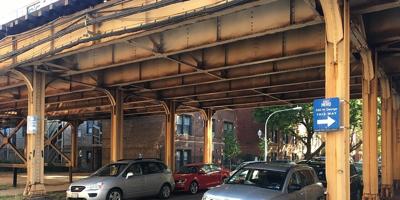


Cars park under the L tracks in Chicago.
CHICAGO — A state appeals panel has agreed with a Cook County judge who slapped the brakes on the CTA’s efforts to stop landowners from renting their parking spaces under and around Wrigleyville L tracks.
Cook County Circuit Court Judge Thomas Donnelly issued a temporary restraining order on July 28, pausing a dispute that started in June when the Chicago Transit Authority sent letters to 16 property owners telling them they’re barred from parking vehicles or storing anything under Red Line tracks between Addison and Grace streets without permission, giving them until July 1 to remove anything and inviting them to contact the agency to learn about paying a monthly fee for parking privileges.
When the landowners’ attorney inquired about the situation, the CTA sent another letter asserting it owned the land in question; stated adverse possession or other means of establishing a property interest wasn’t available because of the CTA’s public use; and moved the deadline for property removal to Aug. 1.
The landowners filed a three-count complaint July 21. They asserted they “have used continuously, adversely, actually, openly and notoriously, asserted exclusive possession of the (land) under claim of title inconsistent with the ownership of the CTA for more than 20 years;” said a recently-introduced city ordinance would, if passed, enshrine their right to obtain parking permits for the disputed ground; and asked the court to endorse their rights and privileges.
In asking Judge Donnelly to dismiss the plaintiffs’ requests, the CTA said they didn’t specifically claim when each named person acquired their property, who owned which structures the CTA wants to remove or when they all began what they claimed was their adverse possession.
In his July 28 ruling, Donnelly struck the landowners’ amended complaint and offered four days to replead, but did agree to the 10-day restraining order inhibiting towing or structure demolition while also ordering the plaintiffs to keep in escrow any revenue collected while the order was in place.
The CTA challenged the ruling before the Illinois First District Appellate Court. Justice Cynthia Cobbs wrote the panel’s decision; Justices James Fitzgerald Smith and Nathaniel Howse concurred. The order was issued under Supreme Court Rule 23, which restricts its use as precedent.
Cobbs said the legal question at this phase is only whether Donnelly’s decision to grant the order involved abuse of judicial discretion, not the merits of the underlying litigation, which will be Donnelly’s purview when considering a preliminary injunction. She further explained the CTA failed to convince the panel of its position regarding the landowners’ claims.
“Although plaintiffs’ filings do not list, for example, exactly which plaintiffs have erected fences or parking structures on their respective pieces of the disputed land, this shortcoming does not affect the CTA or a court’s ability to understand the rights claimed by plaintiffs or the scope of any injunctive relief,” Cobbs wrote. “We also reject the CTA’s assertion that the TRO is ‘overbroad’ because it enjoins the CTA from towing ‘any cars’ or destroying ‘all’ fences, parking tents or other structures on the disputed land.”
The panel rejected concerns about which structures and vehicles are protected and said Donnelly’s order “described the scope of relief with reasonable particularly under the circumstances and adequately maintained the status quo. Thus, we find no abuse of discretion in the breadth of the TRO.”
Regarding the plaintiff’s likelihood of eventual success on their claims of using the land for an extended period without CTA consent or pushback, Cobbs acknowledged “the 20-year period does not begin to run against publicly-owned land that is continuously used for a public purpose.” However, she added, “the fact that the disputed land is publicly owned does not automatically defeat a claim of adverse possession or prescriptive easement. Instead, the doctrine is only a defense where the disputed land is used for a ‘public use,’ which courts have explained means it was used for the general benefit of the public.”
The panel said train tracks “are very likely used for a public purpose” but said the plaintiffs made a good point “there is at least a fair question whether the land under the tracks, which is more specifically at issue here, is for a public use. The record suggests that the CTA has not used the land beneath the tracks at all during the past 20 years. Indeed, plaintiffs explicitly allege that they or their predecessors in interest have borne the burden of cleaning up any debris that has fallen from the tracks as a consequence of normal train operation or track maintenance above. Moreover, plaintiffs have also alleged that their possession satisfied the elements of adverse possession and prescriptive easement listed above, in many cases going so far as to erect fences and parking structures on the disputed land.”
Finally, the panel said the CTA failed to show the temporary restraining order was unnecessary, as Cobbs noted concerns about “potentially unwarranted and extensive intrusion onto the property next to (plaintiffs’) private residences,” as well as the interruption of the business of selling parking spaces during Wrigley Field baseball games and other events, which Donnelly balanced by ordering any funds earned into escrow.