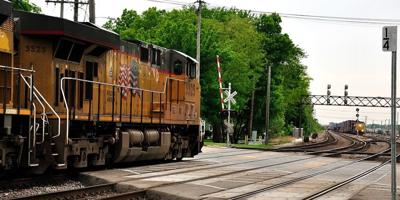


A Union Pacific locomotive
CHICAGO — A federal judge has cleared the way for potentially more than 22,000 truck drivers to move ahead with a class action lawsuit potentially worth many millions of dollars against Union Pacific Railroad for allegedly improperly scanning their fingerprints when verifying the drivers' identities upon entry at UP's secured rail yards.
On Aug. 20, U.S. District Judge LaShonda Hunt agreed to certify the drivers' lawsuit as a class action, formally allowing them to collectively pursue their common claims against UP under Illinois' stringent biometrics privacy law in pursuit of a payout potentially worth tens of millions of dollars, if not more.
In the decision, Judge Hunt denied all of Union Pacific's attempts to either derail the lawsuit or prevent it from proceeding as a class action.
Notably, Hunt specifically rejected the freight railroad company's attempts to argue the digital scans can't be considered fingerprint scans under Illinois law because such scans would not also be counted as fingerprint scans under the criminal investigation standards employed by the Illinois State Police under state law.
The judge, however, said whether or not the fingerprint scans could be used by detectives or crime scene investigators to establish a person's identity is of no matter in this case. Rather, she said, under the Illinois Biometric Information Privacy Act (BIPA), it only matters if UP or the vendors it uses to operate its fingerprint scanners can use the scans to identify the drivers.
"BIPA covers all fingerprints, no matter how they are obtained or presented, so long as the ink print, scan, image, or other medium shows a pattern of ridges and valleys of the finger sufficiently unique to the person and capable of being used to identify them," the judge wrote.
In granting class certification, Hunt also expressly rejected UP's motion for summary judgment. Under summary judgment, a judge can grant victory to one side or another on the merits of the case, without going to trial.
So, the judge's ruling could effectively clear the road for the lawsuit to proceed to either a trial or a settlement.
The lawsuit has been pending in Chicago federal court since 2020. At that time, attorneys from the firms of McGuire Law, of Chicago, and Loevy & Loevy, of Chicago, filed suit on behalf of named plaintiffs David Fleury and Alvin Turner, as well as perhaps tens of thousands of additional truck drivers.
The lawsuit centers on claims that UP allegedly violated the BIPA law when it required truck drivers to digitally scan their fingerprints to verify their identity to enter UP's rail yards in Illinois. According to the lawsuit, UP allegedly failed to first secure consent from the drivers to scan their fingerprints and did not provide the drivers with notices concerning how the fingerprint scans would be used, stored, shared or ultimately destroyed, allegedly as required by the BIPA law.
The lawsuit was one of thousands of class actions that have been filed under the BIPA law against companies operating in Illinois and elsewhere, as trial lawyers have piled into court in pursuit of potentially large prizes through the Illinois law that has proven in the past decade to be a lucrative source of paydays.
The lawsuits have generally accused companies of alleged unauthorized scans of people's so-called unique "biometric identifiers," particularly including fingerprints, but also including scans of people's faces and voices.
The overwhelming bulk of BIPA litigation has landed on employers in Illinois, who have been routinely accused of wrongly scanning workers' fingerprints, faces, voices and other biometric characteristics.
The BIPA law, however, has gained notoriety, thanks to headline-grabbing settlements worth hundreds of millions of dollars apiece in lawsuits targeting tech giants, including Apple, Meta and Google, among others.
The law, to this point, however, has largely allowed trial lawyers to rake in hundreds of millions of dollars in fees paid by businesses targeted by the lawsuits, without ever having to prove any of their clients were actually harmed.
The payouts have primarily arisen from the law's statutory damages provision, which allows plaintiffs to demand damages of $1,000 or $5,000 per violation.
For years, the Illinois Supreme Court had also interpreted the BIPA law to allow plaintiffs to demand $1,000 or $5,000 for each and every fingerprint or other biometric scan they conducted.
When multiplied across an unknown number of scans conducted on potentially thousands of plaintiffs, potential damages could have quickly soared into the many millions or even billions of dollars.
More recently, Illinois state lawmakers took action to reform the BIPA law to explicitly define an "individual violation" as being the first such allegedly improper scan. Thus, damages could only be multiplied per alleged victim, and not per scan.
And, in a separate BIPA case, also involving UP, a federal appeals court ruled that those reforms should apply to lawsuits filed before the legislation was passed, including the lawsuit filed by Fleury and Turner.
However, even with the new damages limits, an ultimate resolution to the case could still generate a relatively large payday for the plaintiffs and their lawyers.
The truck drivers' claims against UP are virtually identical to those leveled against freight railroad BNSF by a group of drivers also represented by the lawyers from the McGuire and Loevy firms. In that case, the company agreed to pay $75 million to resolve the lawsuit.
It is not known if the truck drivers have engaged in settlement talks with Union Pacific.
The truck drivers are represented by attorneys Brendan Duffner, Myles McGuire, Evan M. Meyers and David L. Gerbie, of McGuire Law; and Jon Loevy, Michael I. Kanovitz and Tom Hanson, of the Loevy firm.
Union Pacific is represented by attorney Johanna Spellman and others with the firm of Latham & Watkins, of Chicago and San Francisco.