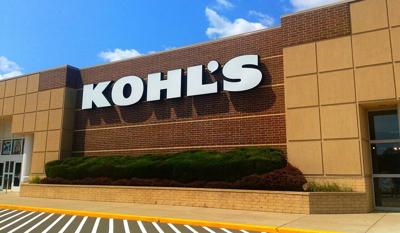


Exterior of a Kohl’s store
CHICAGO — A federal appeals court has asked the Wisconsin Supreme Court to decide if a Wisconsin state law allows customers from across the U.S. to sue retail chain Kohl's over claims the retailer misleads customers over how much money they are actually saving.
The underlying litigation stems from a lawsuit filed by named plaintiff Michelle Cortez Gomez. Gomez claims she bought a $100 portable speaker in May 2023 and said she only did so because of the advertised $30 discount. She said she later learned the chain almost never sold the product at the regular price.
She and other named plaintiffs want to sue Kohl’s under the Wisconsin Unfair Trade Practices Act state law.
U.S. District Judge James Peterson dismissed the complaint, saying a federal law known as the Class Action Fairness Act only gives federal courts jurisdiction over complaints alleging damages of more than $5 million. The judge further said Gomez wasn’t entitled to recover any damages under Wisconsin state law because she couldn't show she bought something defective or worth less than the price paid.
When the case reached the U.S. Seventh Circuit Court of Appeals, Judges Thomas Kirsch, Candace Jackson-Akiwumi and Nancy Maldonado found the question about how to apply Wisconsin state law less clear. They said they could find no prior Wisconsin state court rulings addressing the issue.
So, the Seventh Circuit judges invited the Wisconsin Supreme Court to weigh in on the question in an order issued decision Aug. 3.
The order was issued as a "per curiam" opinion. "Per curiam" is a Latin phrase, meaning "by the court."
The order opened by noting “the line between legitimate enticement and improper deception can be fuzzy, and sometimes retailers cross it in their eagerness to make a sale.”
The panel said the U.S. Federal Trade Commission began regulating price comparison advertising in the 1960s to make sure retailers weren’t citing inflated prices solely to offer purported discounts, thereby creating a false bargain. Like many states, Wisconsin enacted its own price comparison laws. Retailers can only advertise a “claimed regular price,” the panel said, if the goods or services actually were sold at such a price within 90 days before the sale advertisement or if the advertisement discloses when such sales were made.
Whether a class action can proceed, the panel said, depends on whether the complaint alleges a "pecuniary loss" under state law. A pecuniary loss is a legal term meaning a loss of money.
“That’s easier said than done, because no court has discussed pecuniary loss in the context” of the relevant Wisconsin state laws, the panel wrote, “or false price comparison advertising, and there’s a split in the persuasive authority.”
Earlier this year the Wisconsin Supreme Court, in Koble Investments v. Marquardt, held a tenant didn’t show a pecuniary loss despite alleging her lease violated state law because there was no evidence she “suffered any loss from paying rent in exchange for a place to live.” The appeals panel said the Kohl’s argument is similarly rooted in the concept of suffering “loss in the form of a purchase price for a product she was wrongfully induced to buy” and identified three state appellate court decisions supporting the position, albeit not as relates to false comparison advertising.
Conversely, the panel continued, “the Wisconsin Court of Appeals held that pecuniary loss could be either the purchase price of a product or benefit of the bargain damages, depending on the proof,” in a 2014 decision, Mueller v. Harry Kauffmann Motorcars, while several federal court decisions endorse the idea a plaintiff has to allege more than that they wouldn’t have bought something but for the facts their complaint asserts.
“Considering the available persuasive authority, we’re left with a close call on an important question of Wisconsin law,” the panel wrote. “The Wisconsin Supreme Court’s ruling in Koble is ambiguous — it can be read to support either party’s interpretation.”
Even if there was a loss, the panel continued, would it be just the difference between what was advertised and what was paid? Or would a shopper be entitled to keep the product and get a full refund? Because uncertainty about whether a loss exists and, if it does, how to calculate the value, the panel said the Wisconsin Supreme Court needs to decide.
“The case concerns a matter of vital public concern, because every Wisconsin retailer who uses price comparison advertising and every consumer who purchases the advertised products has a potential stake,” the panel said. “Similarly, retail sales are common, and so the issue is likely to recur.”
The panel said its own opinion shouldn’t limit the Wisconsin Supreme Court’s consideration of the question, to the point of reframing the query if needed. The underlying litigation is stayed pending a response.
Gomez is represented in the action by attorney Martin Woodward, of the firm of Kitner Woodward, of Dallas; and attorneys Kiran H. Bhat and Ethan H. Ames, of Keller Postman, of Chicago and Washington, D.C.
Kohl's is represented by attorneys with the firms of Skadden Arps Slate Meagher & Flom, of New York; Godfrey & Kahn, of Milwaukee; and Kelley Drye & Warren, of New York and Parsippany, New Jersey.