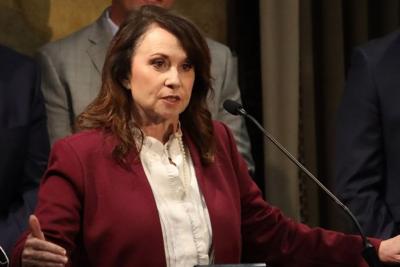



Louisiana Attorney General Liz Murrill
The U.S. Supreme Court has decided that its ruling last week declaring Louisiana’s congressional map an illegal racial gerrymander will take effect immediately even though it means the cancellation of elections and the discarding of tens of thousands of votes.
In a decision on Monday, the high court moved to immediately certify its decision in Louisiana v. Callais instead of its usual practice of waiting 32 days after a court judgment. The court said the appellants in the case “have not expressed to ask this court to reconsider its judgment.” In a dissent, Justice Ketanji Brown Jackson called the move “unwarranted and unwise” and concluded that it departs from the court’s normal practice of not inserting itself into active election procedures.
The appellants, however, on Tuesday filed a motion urging the court to reconsider its order granting the appellees’ motion for prompt certification.
“Appellants intend to request rehearing in this case, and, accordingly, respectfully request that this Court recall the judgment, reconsider its order granting the Application and deny the Application,” attorneys for the ACLU and the NAACP Legal Defense Fund said in the motion.
In the wake of Gov. Jeff Landry’s recent executive order suspending the current congressional elections as a result of the Supreme Court’s decision, the state legislative leaders – Senate President Cameron Henry and House Speaker Phillip Devillier – said in a joint statement that lawmakers were ready to draw up maps that align with the court ruling and put procedures in place to carry out the congressional elections later this year.
“We believe that we have the bills available in the current session to accomplish that work within the remaining month of our regular legislative session,” the legislative leaders said. “We want to stress to voters, as the secretary of state has advised, that it is only the six Louisiana U.S. House seats whose races are being suspended at this time.”
They added that the elections in all other Louisiana races would continue as scheduled.
In the court’s decision last week, justices made it more difficult for voting-rights advocates to use Section 2 of the Voting Rights Act to challenge redistricting maps that end up diluting the voting power of minority groups. To prove a Section 2 violation, litigants must show intentional discrimination and not simply evidence that a map disadvantages minority groups, the court said.
Democracy Docket, a digital news forum founded by voting-rights attorney Marc Elias, reported that more than 40,000 Louisianas have already cast votes using the old congressional map as a result of absentee voting.
Observers have also said that a new congressional map will likely produce at least one additional GOP-leaning district in the state. Under the old map, which contains two majority-minority districts, voters elected two Democratic Congress members and four GOP Congress members.
State Attorney General Liz Murrell praised the high court’s move to require its decision invalidating the old congressional map to take effect immediately.
“This case is a major win for Louisiana,” Murrill said in a prepared statement. “We are moving forward immediately to ensure the constitutional rights of our citizens are protected and to fix the unconstitutional map. Louisiana is continuing to follow the law”
A lawsuit filed by the Elias Law Group on behalf of voter-rights advocates challenging the cancellation of congressional elections was rejected by the 19th Judicial District Court last week.