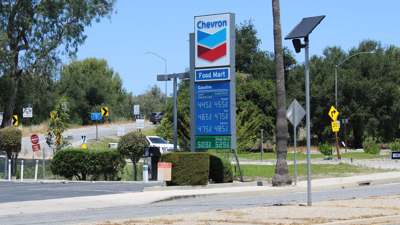



A Chevron station in Simi Valley, Calif.
LANSING, Mich. – The oil industry is attacking Michigan Attorney General Dana Nessel’s attempt to use antitrust laws in a federal lawsuit alleging companies conspired to hold down competition from renewable-energy products.
Nessel sued companies like Exxon, Chevon and BP in January, alleging a “cartel” to maintain dominance in the transportation and primary energy markets that left consumers paying high prices. The companies responded earlier this month in a motion to dismiss that said her claims require more than speculation.
“This is not an antitrust case,” the motion says. “It is an attempt by Michigan to use the antitrust laws to advance its current policy goals of promoting renewable energy over fossil fuels.
“To state a claim, Michigan must plausibly plead standing, an actual agreement among Defendants that unreasonably restrains competition in a properly defined relevant market, and actionable conduct within the statute of limitations. The complaint pleas none of those things.”
While the world waits for the U.S. Supreme Court to decide whether government officials can sue Big Oil for state-law claims like public nuisance and violations of consumer protection laws, Nessel embraced filing in federal court under the Sherman Antitrust Act, the Clayton Antitrust Act and the Michigan Antitrust Reform Act.
Her lawsuit alleged the companies abandoned renewable energy products, used patent manipulation and litigation to hinder competitors and suppressed information about the costs of fossil fuels and the viability of alternatives.
Her lawsuit said electric vehicles would be “rolling off assembly lines in Flint” had it not been for the oil industry. Solar, wind and other energies would power homes and businesses, she said. Fossil fuels would take a backseat if not for the conspiracy, the suit says.
“Instead, Michigan consumers today remain locked in transportation and primary energy markets that have failed to evolve – not because clean alternatives are not viable, but because Defendants have suppressed the conditions for their otherwise-inevitable deployment and adoption,” the complaint says.
The companies say these are points for a political debate – not an antitrust lawsuit – and Nessel can’t show that if they invested more in renewable energy, innovation would have followed.
The U.S. Supreme Court is waiting on briefs in a lawsuit brought by Boulder and will decide if the Colorado Supreme Court was right to let it proceed. Hawaii’s top court reached a similar ruling.
But Maryland’s did not, affirming dismissals of cases in Baltimore and Annapolis. State judges in Pennsylvania, South Carolina, New York, Delaware and New Jersey also threw cases out as improper attempts to regulate emissions.
Alabama Attorney General Steve Marshall led a group of 26 states that said Boulder is trying to “assert a power with no analogue in our Nation’s history and no place in our federalism.”
Republicans in Congress also filed a brief, complaining the Colorado Supreme Court’s ruling created a patchwork of state and local regulations for a market that is supposed to be overseen by federal authorities.
And the Trump administration, which has issued an executive order forbidding any new cases and is battling Nessel in court, submitted its thoughts last year, saying Boulder is attempting to impose new rules that would go far beyond the borders of Colorado.
“If, as the Colorado Supreme Court held, those theories are consistent with federal law, then every locality in the country could sue essentially anyone in the world for contributing to global climate change,” that brief says