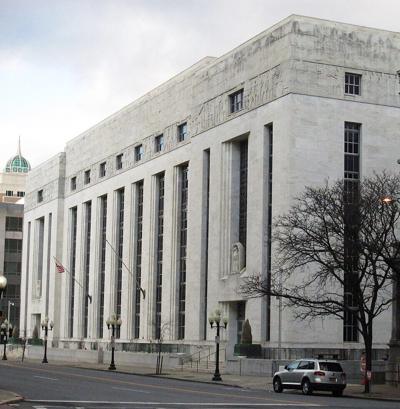


James T. Foley United States Courthouse in Albany, N.Y.
ALBANY, N.Y. – The state’s attorney grievance committee must release the punishment it imposed on one of the top prosecutors in New York after finding misconduct, an appeals court has ruled.
The Third Appellate Division ordered that disclosure Oct. 22 in a win for Campaign for Accountability, which sought release of the details of an admonishment of John Sarcone III, the First Assistant U.S. Attorney for the Northern District of New York. Sarcone served as interim U.S. Attorney before former U.S. Attorney General Pam Bondi appointed him to his current post. Since no one has been confirmed as U.S. Attorney for the district, he essentially heads the office.
Sarcone is alleged to have made false statements that a man had tried to kill him with a knife, though surveillance video didn’t support his claim. Criminal charges against the man were dropped, and CfA also alleges Sarcone has made deceptive statements about where he lives and retaliated against members of the press.
CfA filed a complaint with the New York Attorney Grievance Committee, which found “a sufficient basis for a finding of professional misconduct.” Though it said it punished Sarcone, it did not explain how.
“Mr. Sarcone’s office prosecutes New Yorkers in public every day, yet he fought to keep his own misconduct secret,” CfA executive director Michelle Kuppersmith said. “Today the court made clear that when the state finds a lawyer, let alone a senior federal prosecutor, has broken the rules, the public has a right to know what he did. We look forward to the public release of the admonition.”
The court ruled against CfA’s request for Sarcone’s response to the allegations but held it does have a First Amendment right of access to the punishment, after putting the case through analysis laid out by the federal Second Circuit earlier this year.
That ruling involved ethics complaints against prosecutors in New York and meant CfA had a presumptive First Amendment right that needed to be rebutted by Sarcone. He said disclosure would mark the end of private punishment for attorneys in New York, but the Third Division said it was “unpersuaded” by that argument.
“To the contrary, as this proceeding amply demonstrates and as the Second Circuit itself intimated, all adjudicatory dispositions of a grievance committee will remain private until such time as an application for divulgence thereof is made and it is determined following a full adjudicatory process by the relevant Department of the Appellate Division that the opponent of divulgence has not rebutted any presumptive right of public access which the proponent has established,” the court held.
CfA’s complaint notes a June 2025 incident at a Hilton hotel, where Sarcone was smoking a cigar outside when an undocumented immigrant from El Salvador, Saul Morales-Garcia, began yelling at him while holding a knife.
Sarcone walked toward the lobby and Morales-Garcia retreated, but not before throwing a traffic cone in Sarcone’s “general direction.” The video does not show Morales-Garcia ever in close proximity to Sarcone, CfA says.
Morales-Garcia was arrested, and Sarcone’s statement says he had “pulled a knife out of his pocket and began to charge me in an aggressive manner. It was at this time that I became fearful for my life and I attempted to flee the area. The male was making the motion as if he was going to attempt to cut my throat.”
A news release said Sarcone had been “the victim of a life-threatening incident,” and Morales-Garcia was charged with attempted second-degree murder. Albany District Attorney Lee Kindlon later dropped that charge after reviewing the footage and instead pursued a misdemeanor weapons charge.
Sarcone had told police that his address was at an apartment in a building later discovered to be boarded-up, and news outlets pounced. Especially upset with an article from the Albany Times Union, he removed the publication from his office’s distribution list.