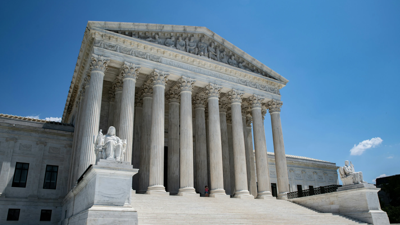


The U.S. Supreme Court stands in Washington.
WASHINGTON - The U.S. Supreme Court could have thrown a life ring to oil companies facing climate litigation last week when it decided Chevron could remove environmental lawsuits by Louisiana parishes from state court to more favorable federal court. But Justice Clarence Thomas appeared to douse those hopes with a single sentence in his majority opinion, saying the federal law that helped Chevron in this case may not apply more broadly to climate litigation.
That may not matter in the long run, however. Not only is the Supreme Court considering a case that could end most climate lawsuits, but state courts are increasingly rejecting a core legal theory behind such cases. Plaintiff lawyers – many working under contingency-fee contracts given out by government officials – have claimed oil companies created a public nuisance by selling hydrocarbon fuels without informing consumers they could warm the atmosphere.
State and federal judges in Pennsylvania, South Carolina, New York, California, Maryland, New Jersey and Puerto Rico have thrown out climate cases seeking money from oil companies to pay for the effects of global warming, seeing them as an improper attempt to regulate emissions. That is the job of regulators and not judges, they say.
“You’re starting to see these rulings in a lot of key jurisdictions,” said Phil Goldberg, managing partner with Shook, Hardy & Bacon who defends businesses targeted by mass-tort suits. “There’s a clear trend going on in these cases that undermines the ability to bring lawsuits all over the place and play jurisdictions against each other.”
In March, the Maryland Supreme Court delivered back-to-back decisions knocking out governmental lawsuits over opioids and climate change. In the first, the court rejected a public-nuisance suit by Anne Arundel County against Express Scripts and other opioid distributors, saying the law can’t be used over tightly regulated and legal products.
To rule otherwise “would permit nuisance liability to be imposed on an endless list of manufacturers, distributors, and retailers of manufactured products that are intended to be used lawfully, when such products are misused and cause injury,” the court ruled in a March 23 decision.
The next day, the court rejected climate lawsuits by Baltimore, Annapolis and Anne Arundel County, saying courts are not the place to decide complex policy questions like the tradeoff between carbon emissions and public welfare. Instead of public nuisance, plaintiff lawyers claimed the oil companies violated state fraud and consumer-protection laws by misleading consumers about global warming. Even if that was true, the court said, oil companies have no “duty to warn the entire human race of the effects of climate change.”
“There is a mismatch between the structure of tort law and the nature of the harm alleged here,” said Justice Matthew Fader in a concurrence. “Tort law is not up to the task.”
The Oklahoma Supreme Court rejected the public nuisance theory behind a $465 million opioid judgement against Johnson & Johnson in 2021, ruling public nuisance applies to “discrete, localized problems, not policy problems.” The Ohio Supreme Court also affirmed state law prohibits public nuisance suits over opioids, as did Delaware and Maine.
Manufacturers often prefer to defend themselves in federal court, where the rules of procedure are considered to be more favorable and predictable and local bias is less likely. Manufacturers of the “forever chemical” PFAS have won some victories on this front, including the Supreme Court’s refusal to overturn a Fourth Circuit Court of Appeals decision removing PFAS suits by Maryland and South Carolina to federal court.
The U.S. Supreme Court appeared to broaden the opportunity to do this with its 8-0 decision in Chevron v. Plaquemines Parish last week. Chevron argued some 40 lawsuits over its drilling and construction activity in Louisiana bayous belonged in federal court under the federal officer removal act, because some of the claims dated to when it produced aviation fuel under government orders during World War II. The court agreed.
Justice Thomas cautioned against reading the statute too broadly, however, saying the phrase “related to” government orders would not mean “the fluttering of a butterfly’s wings” relates to next week’s weather. He went on to cite a D.C. Circuit Court decision refusing to move the District of Columbia’s lawsuit against ExxonMobil into federal court.
Even if climate suits stay in state court, the U.S. Supreme Court may decide their fate next year after accepting the appeal of a lawsuit by Boulder, Colo., against the oil industry. The Supreme Court said it will consider the question of whether federal law preempts such lawsuits under state law, as well as the threshold question of whether it has constitutional jurisdiction to hear the case at all.
In an amicus brief in support of the oil industry, the Trump administration said if local courts could hear public-nuisance claims over global warming, “every locality in the country could sue essentially anyone in the world for contributing to global climate change.”