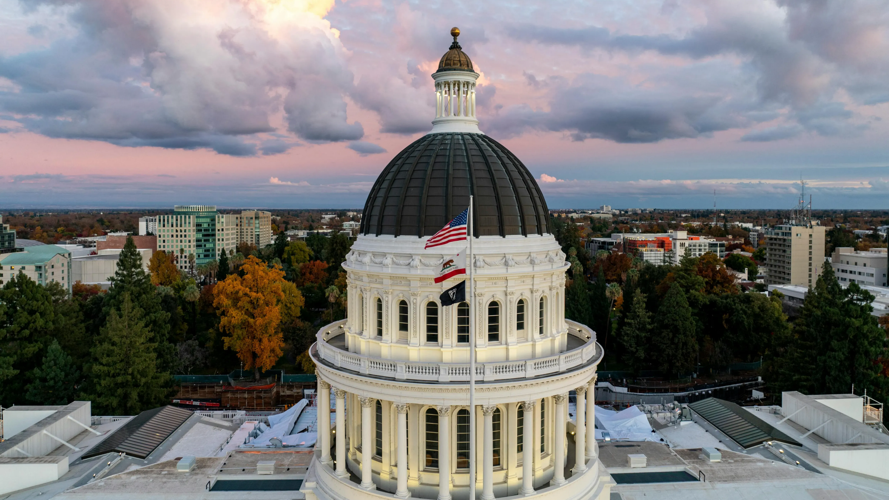




California State Capitol Dome at Sunset in Sacramento
LOS ANGELES — A recent U.S. Supreme Court decision should block California's new mid-decade congressional district map, whether or not voters approved it, as California Democrats have openly admitted they explicitly used race as the leading factor when drawing congressional districts designed to ensure certain districts remained majority Latino or black, according to new filings in the continuing court fight over the congressional district map.
On May 22, the U.S. Justice Department, as well as California Republican voters and elected state representatives, filed a new round of legal briefs in Los Angeles federal court, urging a special three-judge panel to strike down the map drawn by California Democrats.
The filings are the first lodged in the case since the U.S. Supreme Court handed down its decision rewriting the rules governing the use of voters' race when drawing new congressional districts under the provision known as Section 2 of the federal Voting Rights Act.
The filings came in response to a motion to dismiss filed by California Gov. Gavin Newsom and others defending the Democratic California congressional map.
The case, the Justice Department said in its brief, centers on "whether race predominated when the mapmaker and (California state) legislature drew and enacted the map."
"Voter intent cannot supersede constitutional prerogatives. And the United States has sufficiently alleged that race did in fact predominate in violation of the Fourteenth Amendment," the Justice Department wrote.
"Additionally, under the 'updated' framework for interpreting Section 2 of the Voting Rights Act under the Supreme Court's recent ... ruling, the map adopted by the California legislature and enacted by Proposition 50 cannot withstand strict scrutiny."
The congressional district map had been created by California Democrats, led by Gov. Newsom, amid a special mid-decade gerrymandering initiative, in a brazen bid to increase Democratic representation in Congress.
Newsom and his fellow Democrats had asserted the move was needed to counteract efforts by Republicans in Texas and other states to favor the election of Republicans in 2026 and reduce the chances of a midterm Democratic takeover of the U.S. House.
Unlike those other states, California's process required Democrats to take another step: Securing approval from voters directly through a special referendum to "temporarily" amend the state constitution and allow the state legislature to draw the new maps, rather than the state's constitutionally established independent redistricting commission.
That vote was held in November 2025, after Sacramento lawmakers hurriedly approved the new map and forwarded it to voters. During the election, a strong majority of California voters approved the map under the ballot measure known as Proposition 50.
After the Prop 50 vote, California Republicans challenged the law under the Fourteenth and Fifteenth amendments to the U.S. Constitution and the federal Voting Rights Act. They were later joined by the Justice Department under President Donald Trump and the conservative election integrity organization, the Public Interest Legal Foundation, each of which filed their own legal challenges.
All of the legal challenges were consolidated by the federal court into one action.
The lawsuits all asserted the new gerrymandered maps were illegally designed to "shore up" support for Democrats from Latino voters, while also preserving certain districts to ensure black representatives were elected.
While the U.S. Supreme Court has explicitly refused to strike down gerrymanders intended to increase partisan power, the court has considered challenges based on accusations district maps are drawn to favor or dilute the political power of certain racial groups.
Plaintiffs noted the man credited with drawing the maps, identified as Paul Mitchell, explicitly and publicly said he and Democrats intended to use the Prop 50 process to create more majority Latino districts.
Those statements were also echoed by Democratic state lawmakers as the maps were advanced in Sacramento. Court documents assert Democratic lawmakers were presented with tables explicitly showing the racial makeup of all the new districts, not the districts' political demographics.
However, a special judicial panel assigned by the U.S. Ninth Circuit Court of Appeals to consider the challenge, sided with Newsom and the Democrats. They rejected a bid for an injunction to block the state from using the district map in the 2026 elections.

From left, California Gavin Newsom and California Attorney General Rob Bonta
In the ruling, the judicial panel essentially declared Republicans couldn't challenge the Democratic map as an illegal "racial gerrymander" unless they could somehow prove California voters had voted for the maps with the intent to discriminate in favor of Latinos or other racial groups.
The U.S. Supreme Court in February then rejected the challengers' petition on appeal. In that petition, the challengers had warned that allowing that reasoning to stand would establish a precedent allowing states to violate anti-discrimination protections by merely giving voters the chance to approve discriminatory maps.
The Supreme Court's denial meant California would be allowed to continue using the new congressional map for 2026, at least.
However, while the injunction was denied, Republicans and other challengers have not dropped their overall legal challenge, as they seek a decision on the merits of their claims that the maps are illegal racial gerrymanders.
In the meantime, after California Attorney General Rob Bonta and other Democratic lawyers filed their motions to dismiss, the U.S. Supreme Court issued a new ruling that changes how courts must interpret the Voting Rights Act, and particularly Section 2.
In the decision in the case known as Louisiana v Callais, the U.S. Supreme Court ruled that a congressional district map in Louisiana which included two districts specifically drawn to ensure black racial majorities amounted to unconstitutional racial gerrymanders.
Supporters of the map had argued the map should be allowed because it was drawn to comply with Section 2 of the VRA, and ensures black voters in Louisiana have the opportunity to elect a candidate of their choice — ostensibly, a candidate who is black.
While the decision from the court's conservative majority did not explicitly strike down Section 2 as unconstitutional, the court declared that explicitly using race as a criteria to draw legislative districts is unconstitutional.
Further, the court’s majority declared racial minorities do not have a right under the VRA to elect representatives who are of the same race or a preferred race. Rather, the court declared, black, Latino and other racial minority voters have the same voting rights as anyone else.
In the wake of that decision, the challengers to the California congressional map say that map couldn't stand before the ruling, and definitely shouldn't be allowed to stand under the new guidelines laid down by the high court.
Days before the Supreme Court's ruling, California Democrats had moved to dismiss the lawsuit entirely, asserting the challenges fall short of proving the maps were racially discriminatory or unconstitutional violations of anyone's rights.
While the maps resulted in new districts that included majorities or pluralities of black or Latino voters, Bonta and his fellow Democrats said the maps should still be considered constitutional, because their primary purpose was purely to elect more Democrats, a political purpose the Supreme Court has said cannot form the basis of a challenge to legislative district maps.
Challengers said courts should not allow Democrats to use that justification as an escape hatch.
"Partisanship may have been the impetus, but race drew legislative districts with deliberate racial outcomes," the PILF wrote in its response to the motion to dismiss.
If California's Democratic mapmakers "had doubts about the legality of the use of race, Louisiana v Callais has since resolved the questions before this Court," PILF wrote. "... California Defendants and their affiliates admit they drew the congressional lines based on race to 'retain and expand Voting Rights Act districts that empower Latino voters' and to protect two 'historic Black Districts.'"
"... California Defendants cannot enjoy absolution for their unconstitutional racial means and motivations by way of a referendum. Constitutional rights are not left to the whims of the masses."
All three groups of challengers urged the three-judge panel hearing their challenge to reconsider their findings that the results of the Prop 50 referendum makes the race-based considerations of Mitchell and California Democratic state lawmakers irrelevant.
"The startling theory that ... voters can somehow launder the expressly acknowledged racial gerrymander of a mapmaker and the Legislature is novel, alarming, and contrary to the fundamental rights of voters to not be sorted by race into districts designed by their author to favor one race over others," wrote attorneys representing California Republicans.
Further, the challengers noted it also should not matter if the racial considerations of mapmakers were designed to harm a particular race or benefit them.
"Racial gerrymanders ... are illegal and cause injury regardless of whether the
mapmaker’s intent is to empower certain voters or to disenfranchise them," the Justice Department wrote.