
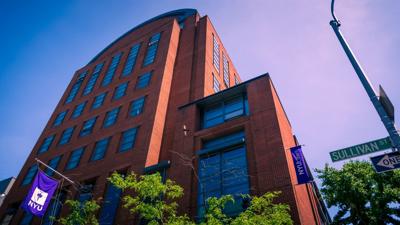


NYU Law School in New York City.
PHILADELPHIA – An antitrust lawsuit challenging fees charged by the Law School Admission Council has been rejected by a Philadelphia federal judge who found arguments “unclear and self-contradictory.”
Judge John Murphy yesterday dismissed the case brought last year by Linvel Risner, who alleged LSAC has a monopoly that charges prospective law students hundreds of dollars for each law school application while doing very little work.
“Focusing on the complaint, as we must, each of Mr. Risner’s claims falls short: the purported economic markets are implausible, the alleged antitrust harms are nearsighted, and there are insufficient allegations of the LSAC’s monopoly power,” Murphy wrote.
Risner is permitted to try again with an amended complaint, as Murphy said his lawsuit “is not without its merits.” Attorneys Peter McCall of Hilgers Graben in Pittsburgh, William Burgess of Atlanta and Bennett Rawicki of Dallas will need to rework their lawsuit to fix flaws identified by Murphy and have just two weeks to do so.
Though individual schools can charge whatever they want for law school applications and sometimes waive those fees altogether, students still must use the LSAC application processing platform. The suit says LSAC does “little more than transmit basic application information” while making more than $30 million annually.
“This astronomical sum is untethered to any actual costs or the value of LSAC’s Law School Application Platform in a competitive market,” the suit says.
“Without LSAC’s unlawful price fixing and monopolization of law school application platforms, law school applicants would not pay the mammoth, standalone LSAC platform fees.”
Students pay a $215 upfront fee then another $45 per application, the suit says, costing them an average of nearly $500 paid to LSAC. Filings for Fiscal Year 2023 show LSAC has $250 million in net assets despite being a nonprofit.
Though the fee LSAC charges has recently increased, applications have not decreased. The lawyers say this is evidence of LSAC’s hold on the market and that there was a 23% increase in applicants in the 2025 cycle.
Murphy did find the alleged conduct is “concerted action” under the Sherman Act. Risner alleged law schools created the LSAC through deans who elect LSAC’s Board of Trustees, with the schools receiving kickbacks from LSAC.
“Whether it is division rivals who play on Sundays or law schools hunting for the best students, we think that a group of competitors’ creation of an entity to do their bidding – in a way materially related to the operation and financial success of their respective businesses – is the type of action subject to Section 1,” Murphy wrote.