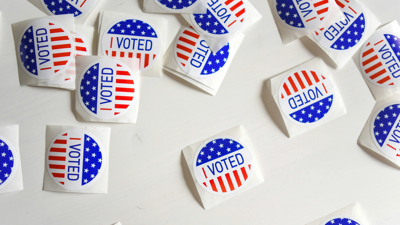



“I Voted” stickers
HARRISBURG, Pa. – Raw voting data from elections in Lycoming County must be seen by the public, the Pennsylvania Supreme Court has ruled in a case that required it to decide whether digital information is the modern equivalent of the “ballot box.”
The justices unanimously ruled against the county Offices of Voter Services and Secretary of the Commonwealth Al Schmidt on Tuesday, finding logs known as “cast vote records” don’t fit the state’s secret-ballot laws. The lawsuit sought the CVRs from the 2020 general election – an effort initially approved by a county judge before the Commonwealth Court reversed.
“Disclosure of the Lycoming County CVRs at issue here does not fundamentally violate the constitutional command of voter secrecy,” Justice Daniel McCaffery wrote.
“We acknowledge Voter Service’s concern that not all counties may follow the same randomization procedures that are established on this record. We recognize that, under certain circumstances, it is possible that a county’s method of generating CVRs may violate the secrecy mandate. But that is a question to be addressed on a case-by-case basis.”
Lycoming County uses ClearVote to manage elections. There is one scanner tabulator in each precinct that reads physical ballots inserted into those scanners, and the results are sent to the county’s central tabulator.
Each precinct produces a CVR, which is a spreadsheet displaying raw data on every ballot cast. Heather Honey started proceedings when she sent a Right-to-Know-Law request to the county for those CVRs. Voter Services denied her request, leading to the long court fight.
Voter Services said CVRs can’t be revealed to the public because of Section 308, which calls the “contents of ballot boxes and voting machines” exempt from disclosure. The trial judge disagreed, calling the language in the law ambiguous and declaring that secrecy for each individual’s vote would be maintained.
The Commonwealth Court reversed that decision in deciding the tabulators are “voting machines.” The U.S. Election Assistance Commission defines the term as something that, among other things, “casts and tabulates the votes.” Two judges on the court dissented because votes are made in the county on paper ballots.
Another appeal followed, asking the Supreme Court to weigh the interests of secrecy with trust that elections are handled competently. For many reasons, it found, tabulators are not voting machines – they don’t have locks and they don’t have a visible counter to show the total number of votes cast during a certain period.
The justices rejected Schmidt’s argument that the contents of ballot boxes and voting machines are “the actual votes or choices made… because that information originates or is derived from either a ballot box or a voting machine.”
“Instead,” the court ruled, “the ‘contents of ballot boxes’ as applied to the facts of this case are the physical ballots actually contained in the ballot box. Ergo, CVRs do not fit within this definition.
“Rather, CVRs are spreadsheets of raw data pulled from the cast ballots. They are not the physical ballots contained in the ballot box.”
Secrecy of votes will be maintained, the court concluded, except in instances when only one voter votes in an election or the results are unanimous. In return, disclosing the CVRs will let the public ensure the number of reported votes matches the number of recorded votes, McCaffery wrote.