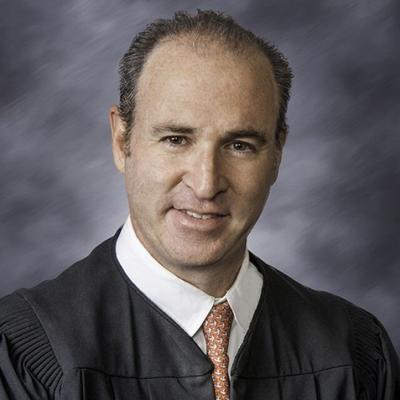


California Supreme Court Justice Joshua Groban
SACRAMENTO — Violent criminals whose participation in crimes result in someone being murdered can no longer be convicted of murder in California, unless they actually shot the victim or played some kind of active, physical role in the act that killed the victim, the California Supreme Court has ruled.
That new interpretation of California law comes as the central part of a decision giving convicted rapist Richard Curtis Morris Jr. a clear path to also challenge and overturn his murder conviction in connection with the 1987 Orange County home invasion, robbery and execution-style murder of strip club owner James Stockwell, aka Jimmy Casino.
The 6-1 decision reversed the decision of a California Fourth District Court of Appeal panel and the decision of an Orange County Superior Court judge.
All of the lower court judges had rejected the petition from Morris challenging his murder conviction and asking to be resentenced in light of California lawmakers' decision to revise state law to make it more difficult for prosecutors to convict certain criminals of murder.
The case centered around a provision in California law that had previously allowed prosecutors and courts to convict criminals of murder if they participated in a violent crime which resulted in the death of a victim, even if they did not personally shoot a murder victim or otherwise commit a violent act that caused a victim's death.
In Morris' case, he was convicted of Stockwell's murder, stemming from the 1987 incident.
According to court documents and published reports, Morris and an accomplice invaded Stockwell's condominium on Jan. 1, 1987, taking Stockwell and his girlfriend captive. They then subdued Stockwell, and handcuffed him.
According to court documents, Morris and the accomplice then allegedly took both Stockwell and the woman upstairs. Morris allegedly took the woman into a bedroom and raped her.
After Morris and his accomplice stole Stockwell's car and fled, the woman reportedly found Stockwell face down on the top of the stairs, still bound and shot to death, in an execution fashion.
The case remained unsolved until 2008, when DNA evidence from a rape kit swab linked Morris to the case.
Morris was then convicted in 2013 and sentenced for the 1987 crimes, including Stockwell's murder. The court agreed at the time that Morris should bear culpability for the murder because his participation in the underlying felonies resulted in Stockwell's violent death.
However, in 2018, California's Democratic governing supermajority and former Gov. Jerry Brown rewrote California law to make it more difficult to convict such people of murder, even if they actively participated in the crimes that led to the murder.
Morris then used that new law to challenge his murder conviction, asserting California law doesn't allow him to be charged with murder since prosecutors did not prove he pulled the trigger on the gun used to shoot and kill Stockwell, only that he participated in the home invasion and robbery and raped the woman.
That petition was rejected in both Orange County Superior Court and on appeal.
But the reasoning found better footing at the California Supreme Court, where justices agreed the changes in the California law should mean Morris gets a new chance to challenge his murder conviction and possibly reduce his life sentence.
In the majority opinion, authored by Justice Joshua P. Groban, the majority, over the objections of the California Attorney General's office, interpreted the state law to now require prosecutors seeking a murder conviction in cases like Morris's to show "the nonkiller aid or abet the actual killer in the lethal act itself, and not just the underlying felony."
To hold otherwise, the majority said, would ignore the changes in the law enacted by the California state legislature.
The majority noted the law changed in 2018 by the legislation known as Senate Bill 1437 "'narrows the felony-murder rule significantly by limiting it to the actual killer and to accomplices who either intend to kill and aid in the murder or play a major role in the underlying felony and act with reckless indifference to human life.'"
They said that change eliminates the courts' prior understanding of the law completely, "because now '[i]t is no longer true that all persons who aided in a burglary or robbery are guilty of murder when one of them kills during that offense...'
"Thus, the question we are presented with here is which individuals remain liable for first degree murder. To allow the now outdated (precedent) ... to dictate our decision here would be circular and inconsistent with the very purpose of Senate Bill 1437’s changes to the felony-murder rule."
Chief Justice Patricia Guerrero authored a special concurrence to Groban's majority opinion.
Like the majority, Guerrero said she agreed the new law significantly narrowed the ability of prosecutors to secure first degree murder charges against accused violent criminals. But she said lawmakers did not make it clear which elements of a crime courts should consider when deciding if someone not only "acted with the specific intent to kill," but whether they should be considered to have committed a murder during the commission of a different crime.
In this case, Guerrero said all agree Morris "acted with the specific intent to kill" in the attack on Stockwell and his girlfriend in 1987. But Guerrero said it was less clear if Morris "helped his coparticipant shoot the victim or ... helped his coparticipant perform the robbery during which his coparticipant committed the shooting."
And since legal rules and principles require giving the defendant all benefits of doubt when deciding if they should be convicted of first degree murder and sentenced accordingly, Guerrero said she believed the court must side with Morris in this case and potentially with other defendants on such questions.
While the state high court's current roster of six permanent justices sided with Morris, the lone dissenter, California Second District Appellate Justice Kenneth R. Yegan who was seated on the case by special assignment, said the majority was too lenient in siding with Morris in this case.
Even under the new felony murder standard established by the California legislature, Yegan said he believed prosecutors had proven Morris was rightly convicted of Stockwell's murder.
"The facts of the instant case demonstrate an uncharged conspiracy and sophisticated plan to commit, at the very least, residential burglary and armed robbery," Yegan wrote. "And (Morris) did assist even under the new majority 'interpretation' of the felony-murder rule. He helped to handcuff the victim in his bedroom before the victim was executed. It is much easier for an actual murderer to execute the victim if he is handcuffed.
"It appears that the only reason why (Morris) was not in the bedroom assisting in the actual shooting, is because he was busy forcibly raping the murder victim’s girlfriend in another bedroom."