
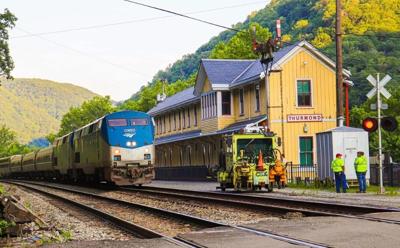



Thurmond Depot is a restored railroad depot located in the historic railroad town of Thurmond.
CHARLESTON – The Town of Thurmond and the New River Gorge Historical Society are asking a federal judge to block the National Park Service from demolishing 12 structures, alleging the agency failed to follow federal environmental and historic preservation requirements before approving the work.
The demolition contractor is scheduled to arrive November 30.
The lawsuit, filed November 18, names the Park Service and Eric G. LaPrice, acting superintendent of New River Gorge National Park and Preserve, in his official capacity. It alleges violations of the Administrative Procedure Act, the National Environmental Policy Act and the National Historic Preservation Act.
The plaintiffs seek an order preventing demolition while the agency completes additional reviews and reconsiders alternatives, including leasing historic buildings to private parties for rehabilitation. The disputed structures include houses and outbuildings in Thurmond, the Prince Brothers General Store in nearby Prince and a pool chemical building at Camp Brookside.
“Plaintiffs do not ask the court to substitute its judgment for NPS’s,” the complaint states. “They ask the court to require NPS to honor its own plans and agreements, and to follow federal law, before taking irreversible action.”
Thurmond, a former railroad center serving southern West Virginia’s coalfields, lies within the national park. Its historic district was listed in the National Register of Historic Places in 1984, according to the complaint.
The plaintiffs contend the demolition decision conflicts with earlier Park Service planning documents supporting preservation, stabilization or reuse of historic properties. They cite the agency’s 1992 development plan for Thurmond, its 2011 general management plan and a historic resource survey completed in 2022.
According to the complaint, the 2022 survey found that most of the Thurmond resources examined retained their historic integrity but needed basic maintenance. The plaintiffs allege the agency failed to undertake recommended stabilization work and then relied on the buildings’ deteriorated condition to justify demolition.
The lawsuit also alleges the Park Service failed to comply with a February 2025 preservation agreement requiring consultation with the town and other participating parties. The plaintiffs say the agreement requires the agency to provide draft demolition plans and schedules, allow 30 calendar days for comments and explain how those comments were addressed.
The town alleges it did not receive a complete demolition plan package. It also says the Park Service circulated a materially revised schedule Nov. 13, two days before the agency said the comment period would close.
The complaint raises concerns about how demolition equipment and traffic would affect town-maintained roads and the 10-ton weight limit on the only bridge into Thurmond.
The plaintiffs argue the Park Service did not adequately consider leasing the buildings rather than demolishing them. According to the complaint, the agency initially rejected a leasing alternative because the park lacked the program, funding and staff to operate it.
A later decision allowed certain structures to remain if viable lease proposals emerged, but the plaintiffs contend the agency did not adequately explain why that approach could not apply to other buildings. A Nov. 13 request for lease proposals did not cover any of the 12 structures identified for imminent demolition, the complaint says.
The Park Service approved a modified demolition alternative in July 2025. According to the complaint, the agency acknowledged that removing buildings would cause long-term harm to the historic district but concluded the project would not have a significant environmental impact. Its decision also relied on planned stabilization and rehabilitation of other historic properties.
The agency describes the broader project as a substantial investment in preservation and infrastructure. A $36 million Great American Outdoors Act allocation will fund work including roofs, windows and storefront restoration along Commercial Row, repairs and rewiring at three historic homes, new water and wastewater plants, and a retaining wall in front of the train depot.
Federal spending records put the demolition order at about $750,000, roughly 2% of the overall project.
The plaintiffs contend that preservation work elsewhere does not remedy the alleged legal deficiencies in the demolition decision. They seek declaratory and injunctive relief rather than monetary damages.
U.S. District Court for the Southern District of West Virginia case number 2:26-cv-00739

