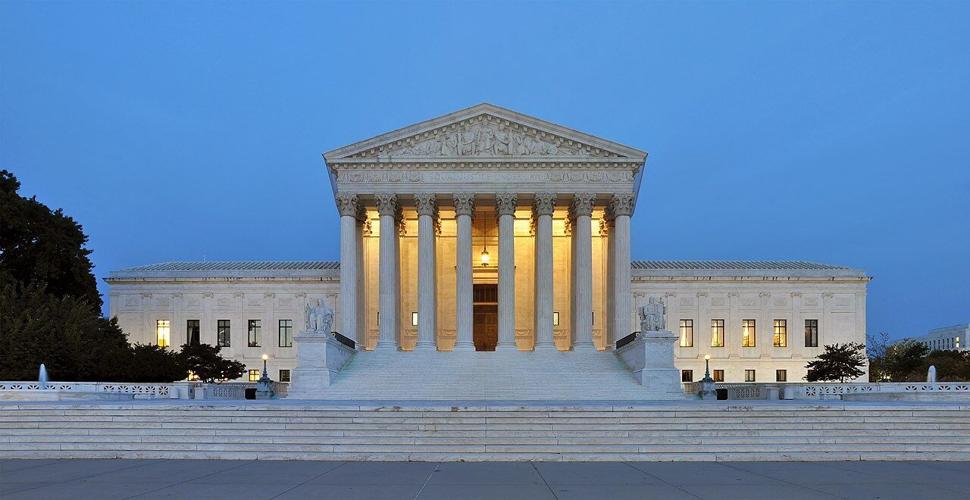




U.S. Supreme Court
WASHINGTON – The U.S. Supreme Court has granted a request to immediately finalize its opinion in the Louisiana congressional map case so the state can draw a new map for this year’s elections.
In a one-paragraph order issued late on May 4, the court said the move was made because Black voters defending the map in question “have not expressed any intent to ask this court to reconsider its judgment.”
Last week, the court issued a 6-3 ruling in Louisiana v. Callais, which struck down the state’s congressional map.
Normally, the court gives the losing party time to ask the court to reconsider its decision and waits 32 days after a decision is issued before sending a copy of the opinion and the judgment to the lower court.

Murrill
Louisiana Attorney General Liz Murrill called Monday’s decision “a major win” for the state.
“We are moving forward immediately to ensure the constitutional rights of our citizens are protected and to fix the unconstitutional map. Louisiana is continuing to follow the law,” Murrill, a Republican, said.
The new map is expected to favor Republicans, who currently hold four of the state’s six seats in the U.S. House of Representatives but could pick up one or even two more under a revised map.
Wednesday’s 6-3 ruling opens the door for conservative state to eliminate districts with heavily Black or Latino residents that often vote Democratic. Chief Justice John Roberts has described the district in question as a snake, stretching more than 200 miles through Shreveport, Alexandria, Lafayette and Baton Rouge.
“That map is an unconstitutional gerrymander,” Justice Samuel Alito wrote in the 6-3 conservative majority ruling. “Section 2 of the Voting Rights Act of 1965 … was designed to enforce the Constitution – not collide with it.
“Unfortunately, lower courts have sometimes applied this Court’s (Section 2) precedents in a way that forces states to engage in the very race-based discrimination that the Constitution forbids.”
Section 2 of the Voting Rights Act of 1965 is the primary voting right’s law protection to challenge racially discriminatory election practices.
A day after the ruling, Louisiana said it would postpone the state’s primary elections for Congress, which were scheduled for May 16.
Republican Gov. Jeff Landry said the use of the 2024 map would constitute the kind of emergency that justifies a postponement under Louisiana law because “electing members to Congress under an unconstitutional map flies in the face of the United States Constitution and subjects Louisiana voters to representatives that are impermissibly elected as determined by the United States Supreme Court, in a 6-3 decision.”
The Louisiana Legislature is scheduled to hear public comments Friday on the new proposed map, which will include one majority Black district. Lawsuits have been filed challenging Landry’s postponement of the May 16 Congressional primaries.