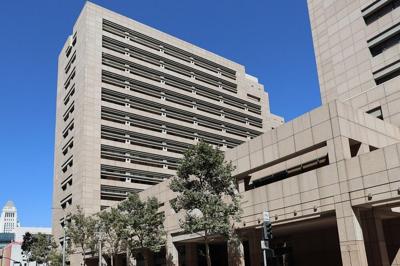


Ronald Reagan State Building, home of the California Second District Court of Appeal, Los Angeles
LOS ANGELES — A state appeals panel has agreed a company can’t be held liable for a vehicle crash involving one of its employees unless the injured party can establish the possibility the person was actually working at the time of the incident, and not just commuting to the office.
Kai-Lin Chang sued Southern California Permanente Medical Group in the wake of a September 2022 incident. According to court records, Chang was bicycling in West Hills when Brittany Doremus, an SCPMG employee who was driving to work, made a sudden left turn and struck Chang. The collision sent Chang to the hospital.
Chang’s negligence lawsuit named Doremus and her employer as defendants, but Los Angeles County Superior Court Judge Gary Micon granted summary judgment to SCPMG, arguing the “going and coming” rule protects employers from liability when their workers are merely commuting.
The company pointed to a deposition from Doremus in which she said she was on her way to the Woodland Hills Medical Center of Southern California, where she worked as a palliative care doctor four days a week, but the accident happened as she turned into a parking lot where she planned to drop family Halloween costumes at a dry cleaner.
In arguing against summary judgment, Chang said work and cellphone records suggest Doremus was texting with coworkers “mere seconds before the collision,” including the fact her Monday schedule often included a team patient conference at the time of the accident. Chang also cited the relevance of Doremus’ work-from-home schedule — half days Wednesdays and when she was on call nights or weekends — and the associated office-provided cell phone and corporate communication software to establish the possibility she was working while driving.
After Judge Micon ruled in favor of SCPMG, Chang brought the issue to the California Second District Appellate Court. Justice Helen Bendix wrote the panel’s opinion, filed April 28; Justices Frances Rothschild and Michelle Kim concurred.
On appeal, Chang argued summary judgment was improper because an employer should have to “negate any possibility” an employee wasn’t in some way working at the time of a vehicle collision. He contested the company’s evidence — call and text logs and screen shots — as unauthenticated, inadmissible hearsay.
“Chang misconstrues the parties’ respective burdens,” Bendix wrote, adding that prior rulings established the utility of a drivers’ testimony they weren’t working at the time of a crash and the onus that puts on a plaintiff to dispute the contention. “Doremus testified she was driving from her home to her office at the time of the accident, and apart from the commute was not doing anything work-related. She did not recall participating in any telephone calls prior to the accident. She was driving a personal vehicle unrelated to her employment. This evidence, if credited by a finder of fact at trial, would establish Doremus was engaged in an ordinary morning commute, and therefore the going and coming rule applies.”
While Chang said a calendar template showed Doremus would usually have a work meeting at 8:30 a.m. Monday, he acknowledged that template is different from her actual work calendar. Further, the panel said that on appeal Chang can’t be allowed to claim call and text logs prove his point while also continuing to maintain that same information was inadmissible as evidence.
“The call log indicates Doremus was not on a call at the time of the accident, and while the text log lists text messages with coworkers at 8:44, the screenshot indicates those texts occurred after the accident, when Doremus informed her coworkers she would not be coming in,” Bendix wrote. “In other words, the documentary evidence does not contradict Doremus’ testimony that when the accident occurred, she was not communicating with coworkers or otherwise working.”
Chang also failed to sway the panel on his alternative theory, that the coming and going rule is inapplicable to a hybrid and on-call worker like Doremus who can perform duties equally well at home or in the office. He argued summary judgement would be improper if there was a chance to show at trial that the employer “obtained at least an ‘incidental’ benefit from literally everything Doremus did that was anything other than purely personal” and likened her driving as “more akin to traveling between worksites than it is to a ‘common commute.’ ”
The panel said Doremus’ work schedule doesn’t change the fact she was headed to the office and doing a personal errand on the way. It rejected Chang’s framing to the extent it relied on worker compensation litigation, first noting those cases are different from the liability standards at issue in a personal injury lawsuit, adding that even if such precedent were applicable, it wouldn’t change the outcome.
Quoting a 1976 California Supreme Court opinion, Wilson v. Workers’ Compensation Appeals Board, which case involved a teacher who couldn’t qualify for worker compensation payment after being injured during a commute to school even though she sometimes graded papers at home, Bendix said there is an exception to the going and coming rule:
“Work done at home may exempt an injury occurring during a regular commute from the going and coming rule if circumstances of the employment — and not mere dictates of convenience to the employee — make the home a second jobsite. If the home becomes a second business situs, the familiar rule applies that injury sustained while traveling between jobsites is compensable. …
To the extent Chang could possibly show Doremus’ house was a “worksite,” Bendix said, he couldn’t do so for an incident that happened on a Monday morning when she was driving to the worksite. Whether employers benefit from hybrid work arrangements, the panel said, doesn’t address the legal question of when an employee can be said to be working for the purposes of assigning liability to a company.
Adopting Chang’s position, Bendix concluded, “would eviscerate the going and coming rule for employees who sometimes work from home, thereby discouraging employers from allowing employees that flexibility. We fail to see what policy this serves.”
The panel affirmed the judgment and awarded SCPMG the costs of defending the appeal.
Chang is represented by Alexander & Yong.
The Medical Group is represented by Manning Gross + Massenburg.