







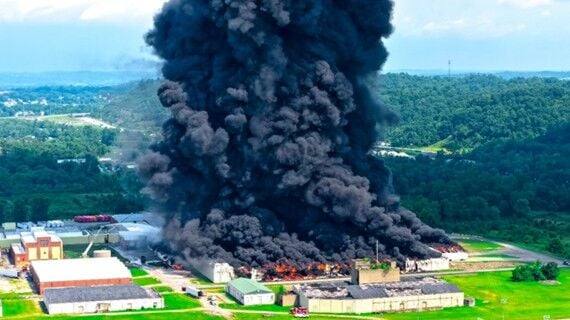
The fire at the People’s Cartage warehouse in Parkersburg began July 4 and reignited July 5, according to the class action lawsuit filed July 7.
CHARLESTON – A federal judge has appointed four Charleston attorneys as interim class counsel in a proposed class-action lawsuit over a Parkersburg warehouse fire that residents say exposed their neighborhoods to smoke, ash and soot over the Fourth of July weekend.
U.S. District Judge Thomas E. Johnston granted the unopposed motion November 4 in the lawsuit filed by James Leonard Anthony and Doris Jean Anthony against Peoples Cartage Inc. and parent company Total Distribution Inc.

diTrapano

Majestro

Forbes

Layne
The attorneys appointed are L. Dante diTrapano of Calwell Luce diTrapano, Anthony J. Majestro of Powell & Majestro, W. Jesse Forbes of Forbes Law Offices and Bernard E. Layne III of Mani Ellis & Layne.
The two-page order grants the Anthonys’ request to appoint counsel for the proposed class. It does not certify the class, resolve the allegations against the companies or award damages.
The Anthonys filed their complaint July 7, alleging safety failures at Peoples Cartage’s Camden Avenue warehouse allowed a fire to reignite and spread, sending thick black smoke over nearby homes and businesses. The couple lives on Pennsylvania Avenue near the warehouse.
The proposed class includes residents, business operators and property owners or possessors within the area covered by a shelter-in-place order, as well as the broader area affected by smoke, ash and soot. The complaint says the class likely includes more than 100 members with combined claims exceeding $5 million.
According to the complaint, the initial fire broke out about 10:40 a.m. July 4 in a storage box containing plastic pellets. The pellets, used in manufacturing plastics, were stored in large cardboard boxes stacked as much as 16 feet deep.
The warehouse’s sprinkler system and firefighters were believed to have contained the initial blaze, the complaint says. The plaintiffs allege the companies later shut off the sprinklers because water was soaking other boxes and managers feared the stacks could collapse and endanger workers. A fire watch was established while activated sprinkler heads were replaced, according to the filing.
About 5:30 a.m. July 5, before the sprinkler system was restored, employees or agents began removing and opening boxes damaged in the first fire, the complaint alleges. Material in one box reignited when exposed to air, and flames spread rapidly through the facility.
The complaint says the resulting fire required an extensive response, including roughly 30 tanker trucks hauling water and an industrial firefighting service installing a supplemental line from the Little Kanawha River. A shelter-in-place order remained in effect until about 2 p.m. July 7.
The Anthonys allege they and other proposed class members experienced interference with the use of their homes and businesses, contamination requiring cleanup, respiratory and other health effects, and potential long-term health consequences.
The lawsuit also cites fires and hazardous-waste violations at a separate Peoples Cartage facility at Airport Industrial Park near the Mid-Ohio Valley Regional Airport. The plaintiffs contend that history put the companies on notice of foreseeable fire risks but that they failed to adequately assess or correct conditions at the Camden Avenue warehouse.
“This was not simply an unavoidable industrial accident, but the result of a series of decisions and missteps allegedly made despite known fire risks, prior incidents and prior regulatory action,” diTrapano previously told The West Virginia Record. “Those allegations warrant a full accounting of what occurred and why this community was placed in harm’s way.”
The lawsuit asserts claims of negligence, private nuisance, trespass, strict liability and reckless conduct. The Anthonys seek compensatory damages for property losses, cleanup costs, business losses and personal injuries, as well as punitive damages, interest, attorney fees, court costs and other relief.
U.S. District Court for the Southern District of West Virginia case number 2:26-cv-00447