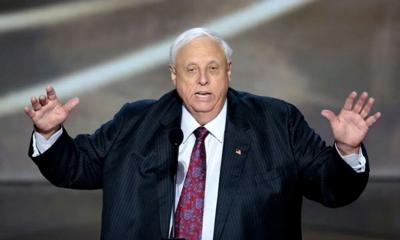



Sen. Jim Justice (R-W.Va.)
BLUEFIELD – Four retired miners and the United Mine Workers of America are asking a federal judge to hold five coal companies owned by U.S. Sen. Jim Justice’s family in contempt, alleging the companies are replacing negotiated health benefits with a reimbursement arrangement that shifts costs to retirees and leaves some beneficiaries uninsured.
In a supplemental brief filed November 16, the plaintiffs urged U.S. District Judge David Faber to enforce a 2021 permanent injunction requiring uninterrupted health care and prescription drug coverage for eligible retirees and their dependents. They contend the companies’ recent efforts to move retirees into Medicare-related coverage do not satisfy that order.
The defendants are Justice Energy Co. Inc., Keystone Service Industries Inc., Bluestone Coal Corp., Double-Bonus Coal Co. and Southern Coal Corp. The plaintiffs are James E. Graham II, Dennis Adkins, Roger Wriston and David B. Polk, along with the UMWA.
The dispute dates to August 2019, when the retirees and union sued to enforce benefit obligations under collective bargaining agreements. The litigation has continued through repeated complaints about coverage interruptions. The union has said intermittent prescription coverage lapses had affected 250 to 300 recipients in recent years.
The latest brief follows an October 19 hearing on a contempt motion filed in April. The plaintiffs describe it as their third contempt motion and argue that earlier efforts to safeguard benefits have failed.
“Most recently, and in anticipation of the October 19, 2026, hearing, Justice undertook a scheme to sign up retirees/beneficiaries to a unilaterally imposed Medicare Advantage program,” the brief states.
The plaintiffs allege the replacement coverage is inferior to the negotiated employer plan and leaves some beneficiaries younger than 65 without health insurance.
In an accompanying declaration, UMWA International President Brian Sanson said the companies sought to replace their obligation to provide a negotiated package of benefits with fixed monthly reimbursements, requiring retirees to obtain insurance and pay premiums, deductibles, copayments and other expenses.
Sanson described proposed monthly payments of $441 for medical reimbursement, $175 for prescription drug reimbursement and $43 for premium reimbursement, totaling $659. He said those amounts would be insufficient to replace the negotiated benefits and would shift financial and administrative burdens to retirees.
Under the proposal, Sanson said, retirees would have to navigate insurance choices they previously relied on the union to negotiate and the companies to administer. He warned that beneficiaries unable to afford expenses beyond the reimbursement amounts could forgo supplemental coverage or treatment.
The brief, filed by UMWA attorney Kevin F. Fagan, quotes defense counsel as acknowledging the coverage problems that prompted the April contempt motion.
“The UMWA had every reason to file this motion back in April,” defense attorney Hatfield said at the October hearing, according to a transcript excerpt included in the filing. “The coverage that existed was inconsistent, inefficient, and not sustainable” because of the defendants’ limited operations and resources.
Another excerpt quotes Hatfield as saying the companies were continuing to help eligible beneficiaries enroll in coverage. For those ineligible for Medicare, he said, the companies intended to use escrow funds or other resources to reimburse out-of-pocket expenses or premiums for individual health insurance.
The plaintiffs argue that reimbursing expenses does not substitute for providing the uninterrupted coverage required by the court’s injunction.
The June 3, 2021, order required the companies to comply with the 2016 National Bituminous Coal Wage Agreement and related memoranda of understanding unless modified or superseded by future agreements. It prohibited terminating or modifying retiree coverage inconsistently with those agreements.
A separate 2022 agreement required a $175,000 escrow account to safeguard health and prescription benefits during payment failures. Withdrawals were to be replenished within 10 days. The agreement expressly stated that establishing the account did not discharge or modify the companies’ underlying benefit obligations.
According to the plaintiffs, bank records showed the account maintained the required funding level for only about six days after being funded in January 2023. They allege its balance had been below $100 since February 2, 2024.
The plaintiffs have also sought appointment of a special master to administer an account outside the companies’ possession, monitor funding, process transfers needed to maintain benefits and report noncompliance to the court. They argue that creating a new escrow account would not resolve the dispute if the companies continue providing benefits below the negotiated level.
The November 16 brief asks Faber to find the companies in contempt, award retirees and eligible dependents reimbursement for out-of-pocket expenses incurred during prescription coverage lapses, order payment of attorney fees and impose sanctions to compel compliance. It is a request for relief, not a ruling that the companies violated the injunction.
Last week, Justice was publicly admonished by the Senate Ethics Committee for violating federal law and Senate rules by failing to file his annual financial disclosure on time despite two extensions and repeated reminders.
U.S. District Court for the Southern District of West Virginia case number 1:19-cv-00597